
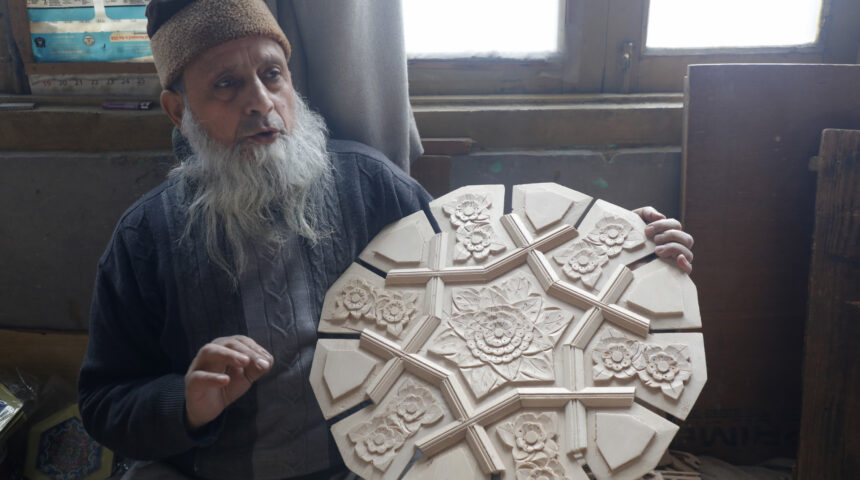
Khatamband is an art of making ceilings by fitting small pieces of wood (preferably walnut or deodar wood) in geometrical patterns. These are entirely hand crafted and fitted with tongue and groove joints, without use of any nails. Processed wood is cut into panels and fixed onto the ceiling in floral and geometrical designs. As with most other crafts of Kashmir, it is believed this craft too was brought to Kashmir by Shah-i-Hamdaan, who traveled to Kashmir from Persia along with several craftsmen. While some believe it was brought to Kashmir in 1541 by Mirza Hyder Doulat. Few of these...
Blog
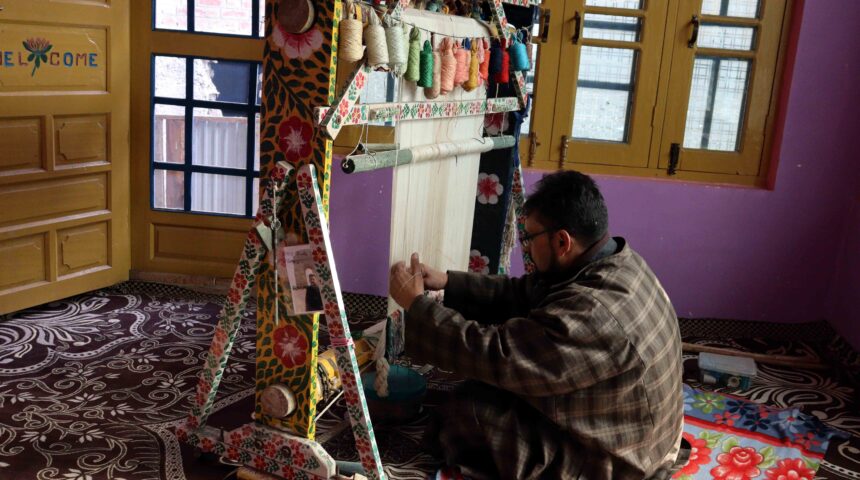
Photo Essay: Kashmir carpet (Kal Baffi)
Kashmiri carpets are the hand-knotted categories of carpets and are made by tying knots. These carpets are made in a karkhanas where the skilled weavers work. The origin of hand knotted carpets locally known as Kal baffi dates back to the 15th century and is said that the skilled craftsmen were brought to Kashmir by Sultan Zain-ul-Abiddin from Persia and central Asia to train the locals. Ghulam Ali Sheikh has been creating carpets for over 30 years in his karkhana at his house in Kokernag Village. Kaleen taleem is the instruction manual that specifies the number of strands of yarn...
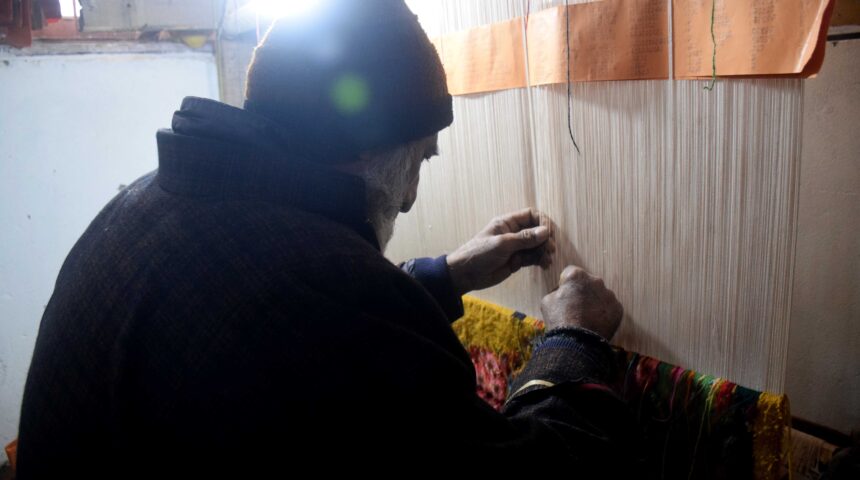
Photo Essay: Pashmina carpets
Shahnawaz Ahmad Sofi, son of Gul Mohammad Sofi, a resident of Rathpora Eidgah Srinagar, completed his graduation in 2003 from the Institute of Music and Fine Arts and used to make portraits and was passionate about colours. After his graduation he took up his old family business of carpets (since 1950s) and decided to revive a 200 year old craft of single knot Pashmina carpets. It is believed that a few British factories in Srinagar used to make such carpets during the Dogra rule. Sofi decided to revive this art and began with converting his art, including 3D art, in...
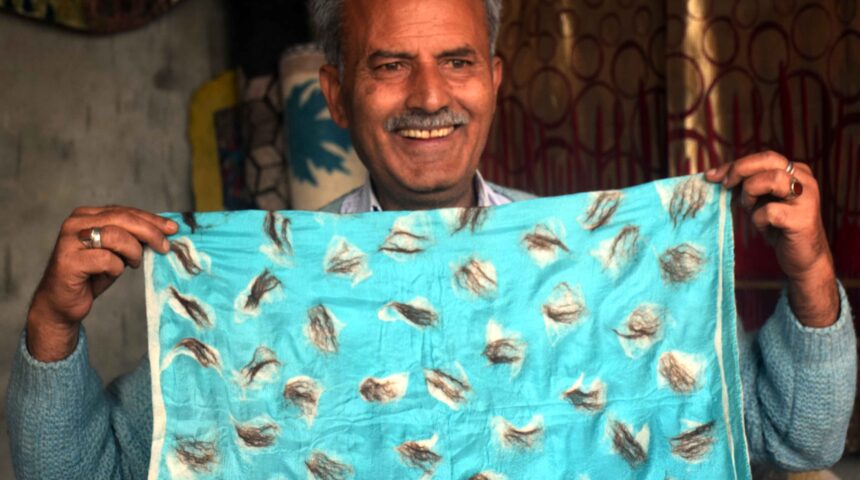
Photo Essay: Nuno Silk Scarf
Farooq Ahmed, of downtown Srinagar, who has mastered the fusion art of the traditional making Kashmiri Namda with nuno felting has taken it a step further to create silk scarves with nuno felting technique. Farooq Ahmed is the only artist in India who has merged these two techniques to produce Namdas, silk scarves etc. It took him nearly two years to learn this skill, and was assisted by a Delhi-based designer in learning this technique. The sheep wool is sourced from Ludhiana (which is also used for the semi-pashmina shawls) while the fine silk (passes through a ring) is produced...
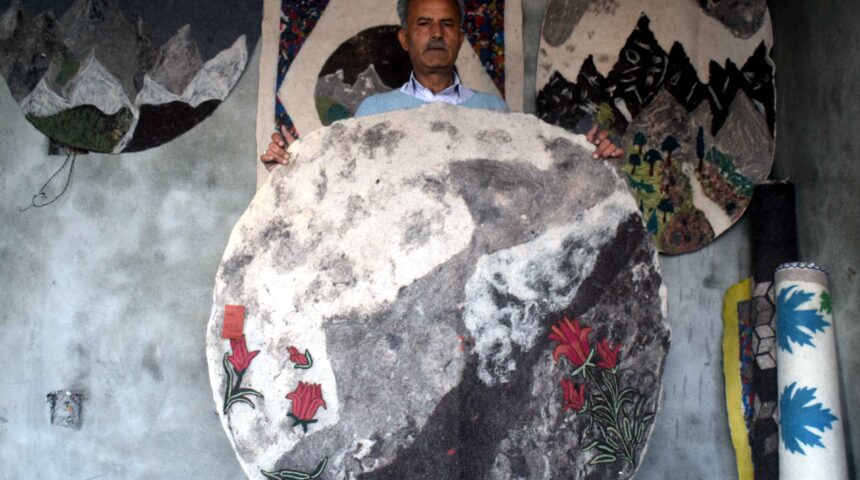
Photo Essay: Namda and Nuno Felting
Kashmir has been known for its Namda rugs made of sheep wool, which came in to Kashmir from Central Asia. Kashmiri Namda rugs are non-woven rugs developed by highly skilled artisans in Kashmir using the felting technique. These floor coverings are primarily made of pure sheep wool, as wool has a natural property to felt. Broadly there are three methods of felting: wet felting, nuno felting and needle or dry felting. There are processes, namely ‘felt knits’ and ‘artfelt’. Artfelt is a type of paper very much like a dissolvable interfacing; however, while dissolvable interfacing will fall apart once any...
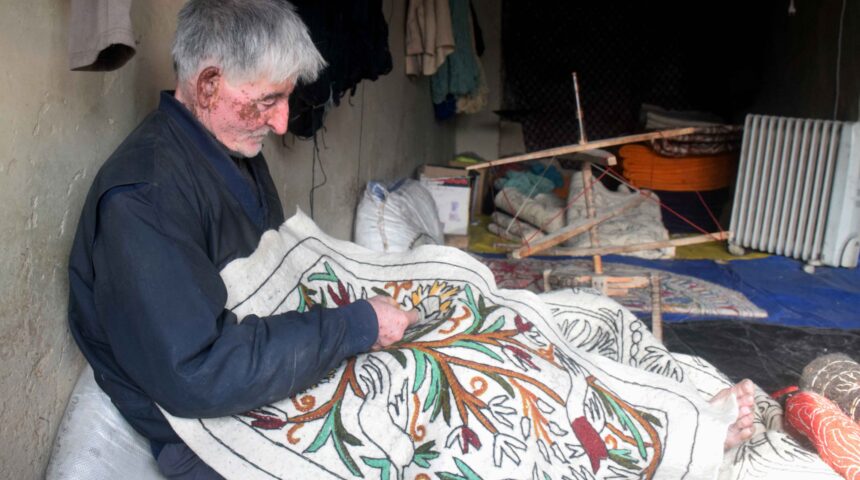
Photo Essay: Jalakdozi Namda
Chain Stitch, known as Jalakdozi in Kashmiri is a chain stitch embroidery done on rugs called Namda made of sheep wool. Namdas came in to Kashmir from Central Asia, however, there was a locally crafted rug called gabba, an embroidered Kashmiri rug. Made by re-purposing old woollen blankets and waste cloth, a gabba is used as a carpet, prayer rug, blanket and mattress and is usually reserved for weddings or as home furnishings. Gabbas are traditionally made by Kashmiri women during the winter. To make the gabba, the used cloth is first washed thoroughly, then milled and dyed in various...
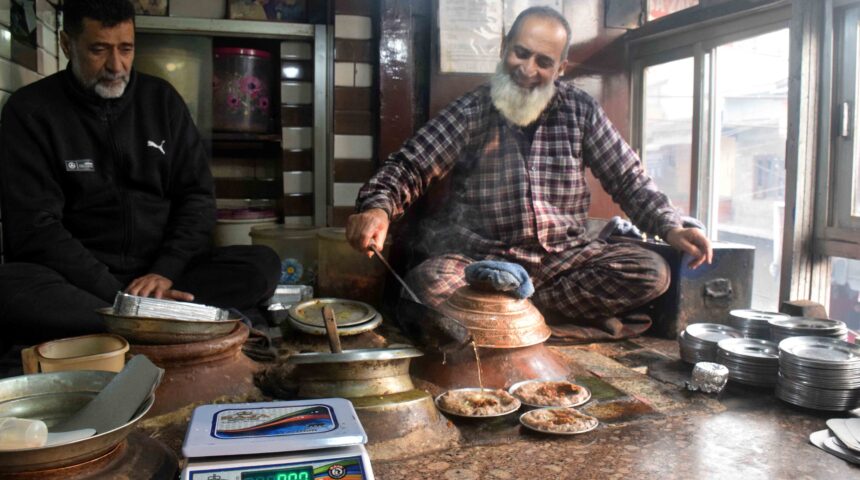
Photo Essay: Harissa, the satiating winter morning dish.
Harissa, not to be confused with the hot red chilli pepper paste (another version is with rose petals) of Maghreb (Tunisia, Morocco, Algeria and Libya), is a winter breakfast dish of Kashmir, perhaps more of just Srinagar. A few dozen harissa shops, mainly in old Srinagar, the downtown area or the Shehar-e-Khaas, begin a routine around October that lasts till March. This centuries-old delicacy is a must-have breakfast meal in the harsh winters of the valley. Harissa came to Kashmir in the 14th century, and the Srinagar city has been serving it for over 200 years. It is said that...
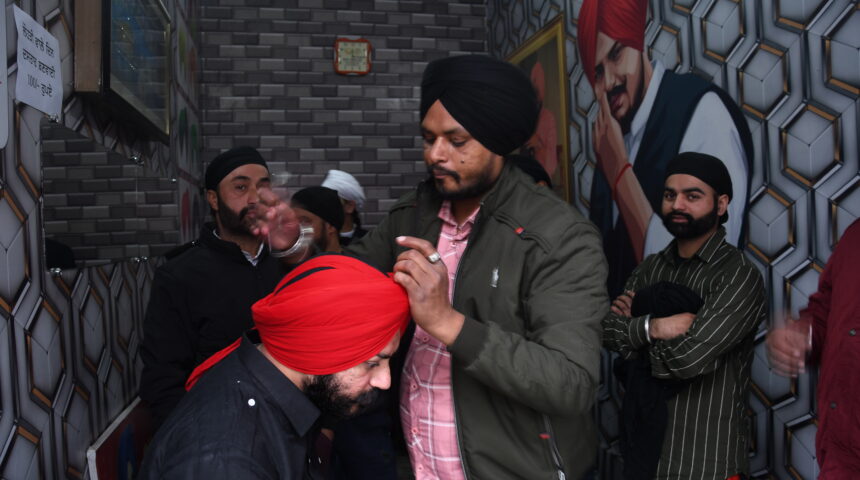
Photo Essay: Tying the Punjabi Pagg
Vikramjit Singh (Vicky) of Amritsar has been tying turbans for the last 12 years. What started as a hobby became his profession over the years. On an average he ties turbans for 40-50 people daily. These people of mixed communities tie turbans for various occasions, including weddings and also just out of interest. Vicky can tie 5-6 styles of turbans. A turban (from Persian dulband) is a type of headwear based on cloth winding. Featuring many variations, it is worn as customary headwear by people of various cultures. Communities with prominent turban-wearing traditions can be found in the Indian subcontinent,...
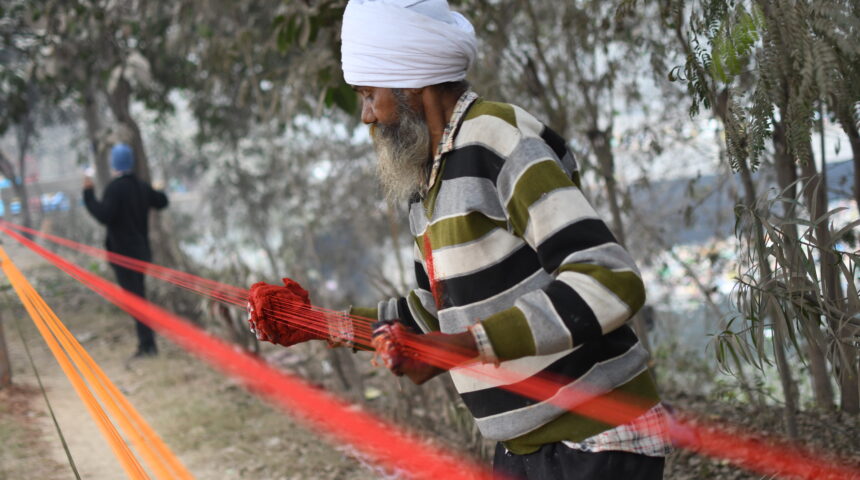
Photo Essay: Dor making tradition of Punjab
Kite (patang or guddi in Punjab) flying has been one of the major cultural activities for the people of the Subcontinent, especially of Punjab. Kite flying is popular on Lohri and Baisakhi. Kite flying festivals and competitions were popular even before and during the time of Maharajah Ranjit Singh and remained so in undivided Punjab, Lahore being the main hub, especially during Basant. Vadodara, Surat and Ahmedabad are the other main cities where kite-flying is considered and celebrated as a festival known as Makar Sankranti (Uttarayan), which marks the beginning of spring and welcomes the sun after long winters. The...
PhotoEssay: Art of Papier Mache, Kashmir
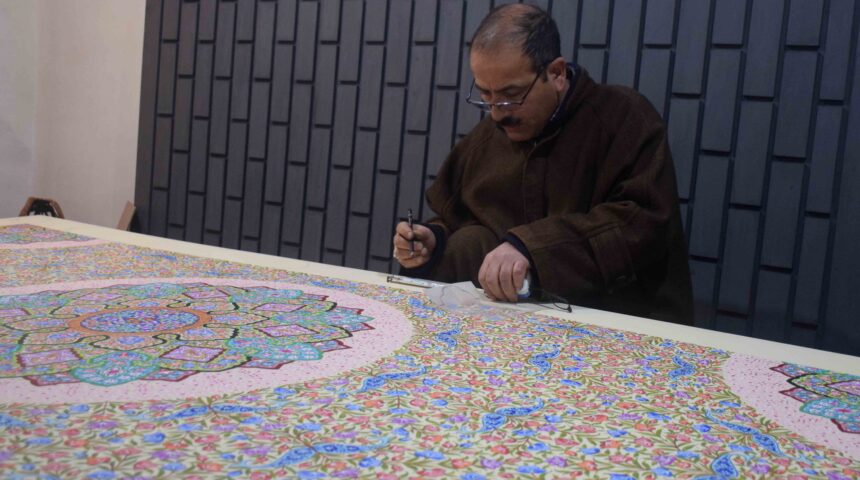
Kashmiri papier-mâché is a handicraft of Kashmir based primarily on paper pulp, and is a richly decorated, colourful artifact; generally in the form of vases, bowls, or cups (with and without metal rims), boxes, trays, bases of lamps, and many other small objects. These are made in homes, and workshops, in Srinagar, and other parts of the Kashmir Valley, and are marketed primarily within India, although there is a significant international market. The product is protected under the Geographic Indication Act 1999 of Government of India, and was registered by the Controller General of Patents Designs and Trademarks during the...
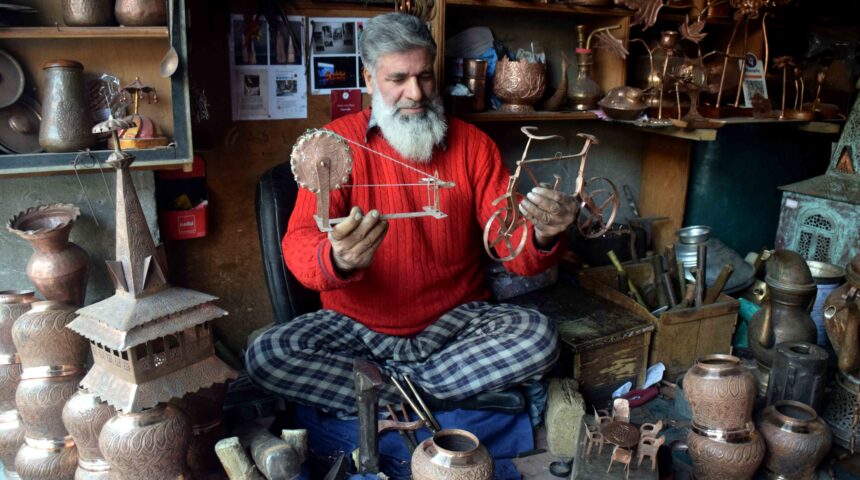
Photo Essay: Copper innovator, Srinagar
Near the historic Khanqah-e-Moula in Srinagar, is a small shop of copper ware of artisan Mohammad Aslam Bhat. Named Vanposh, the shop has a unique collection of copper items like a spinning wheel (yender in Kashmiri), beautifully handcrafted clocks, table lamps and other creative items made of copper. Bhat learnt the craft from his maternal grandfather Ghulam Nabi Misgar who was also a copper-smith. There was a time when copper ware was only associated with utensils, but Bhat has been credited with breathing new life into old techniques by bringing forth new designs and products ranging from motifs of Valley...
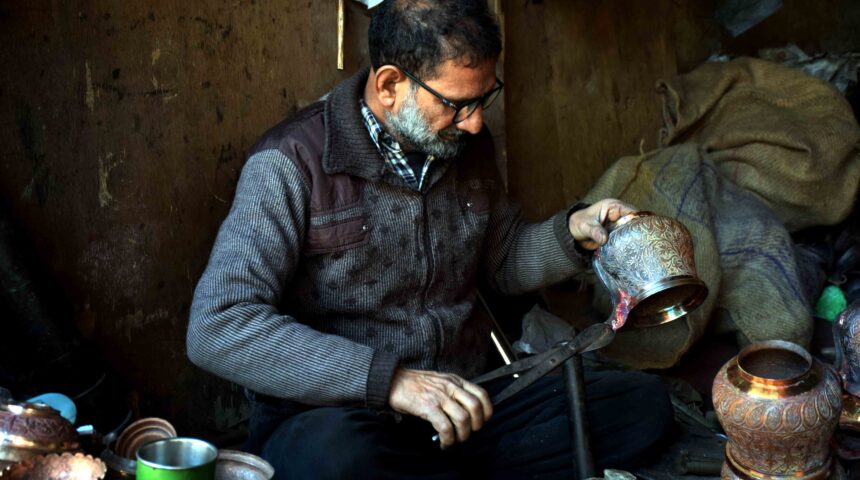
Photo Essay: Copper work of Kashmir (Kand Kari)
As with most other crafts of Kashmir, history has it that the Sufi Saint, Mir Syed Ali Hamdani ,who travelled from Central Asia was instrumental in making copper popular in Kashmir. He brought craftsmen from central Asia to train locals. However, the copperware craft flourished during the reign of King Budshah Zain-ul- Abideen. In the Mughal era, metalwork in Kashmir was focused more on making gun barrels and swords. Techniques of casting and forging Iron along with Meenakari (enamelling) as it is commonly known were used for decorating the handles of swords. By the end of the 19th century with...