
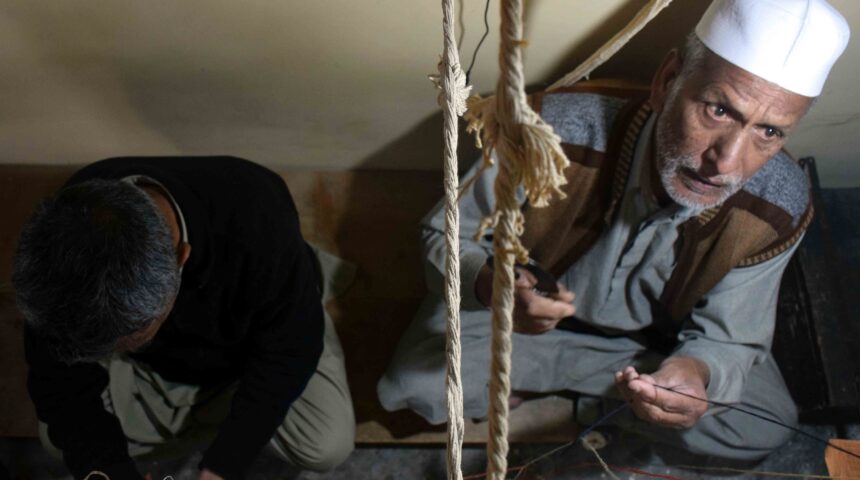
When Manzoor Ahmad Khan was barely ten years old, he found himself drawn to the rhythmic movement of hands and threads in his neighbour’s home in Kashmir. Watching Abdul Khaliq Mir weave carpets, he felt an instinctive pull towards the craft – one that would quietly shape the next six decades of his life. Under Mir’s guidance, Khan learned the basics of carpet weaving, gradually mastering its most intricate techniques through years of patience and practice. Today, at seventy, Khan stands among Kashmir’s most respected carpet artisans. His work has earned him major recognition, including the National Award for handmade...
Blog

Photo Essay: Art of Aari Work – The Timeless Craft of Abdul Majeed
Abdul Majeed, an 85-year-old award-winning Kashmiri artisan, is among the last masters of Aari (Staple) work—a delicate form of landscape embroidery once celebrated across the Valley and beyond. He learnt the craft in his youth, at a time when Aari work was rising in popularity in Kashmir, inspired in part by the efforts of a foreign woman, Ms. Helen, who helped popularize the technique. Over the decades, Majeed’s embroidered landscapes, rich in detail and rooted in Kashmir’s natural beauty, brought him national acclaim. His work even reached the hands of Indira Gandhi, who was so impressed by his embroidered depiction...

Photo Essay: A World in Colours – Six Decades of Naqashi Mastery
Mirza Altaf Hussain Beigh, a 66-year-old Papier Mâché Naqashi artisan from Srinagar, has devoted his life to a craft he began learning at the age of six. With nearly six decades of experience, he stands among the last Kashmiri masters who carry the traditional skill of Naqashi, an intricate art involving the hand-painting of vivid motifs and patterns on Papier Mâché objects. From vases and jewellery boxes to photo frames, decorative eggs, and wall plaques, Mirza’s work reflects a deep-rooted aesthetic heritage, drawing from centuries-old Kashmiri design traditions. Despite his mastery and long-standing commitment to preserving this delicate craft, national...

Photo Essay: The Last Keepers of Kashmir’s Chainstitch Tradition
One of Kashmir’s renowned embroideries, Chainstitch, continues to survive in the nimble hands of 72-year-old Abdul Qayoom Wani from Srinagar, who has dedicated nearly 55 years to this intricate craft. Having learnt the art from his father, Mohammad Ramzan Wani, he has witnessed both its flourishing years and its slow decline. Known for the enchanting texture it lends to fabric, Chainstitch today faces an uncertain future due to dwindling demand, market pressures, and waning interest among the younger generation. Wani recalls a time when young artisans eagerly sought to master Chainstitch, but now expresses deep regret as he watches the...

Photo Essay: Saving Copper Naqashi – The World of Manzoor Ahmed Naqashgeer
60-year-old copper naqash, Manzoor Ahmed Naqashgeer of Teingpora Nawakadal in Srinagar, is one of the last remaining masters of Kashmir’s centuries-old copper naqashi tradition. Copper utensils – once an essential part of every Kashmiri household – are renowned for their exquisite hand-carved designs created by skilled naqashis. But today, this heritage craft is under grave threat as cheaper, machine-made products dominate the market and push handmade artisans to the margins. Manzoor Ahmed has devoted 45 years to perfecting this delicate art, having learned copper carving in his adolescence from his father, Mohammad Subhan Naqashgeer, continuing a family lineage of over...

Photo Essay: Echoes in Walnut – The World of Rafiq Najar
Mohammad Rafiq Najar is a 65-year-old master walnut wood carver from Naidboni in Rainawari, Srinagar, who has dedicated over four decades to the intricate traditional craft of Kashmiri walnut wood carving—a heritage art known for its detailed patterns and cultural significance. He inherited the craft from his father, Noor Mohammad Najar, and became known for his exquisite wood panels, furniture elements, and decorative pieces that reflect Kashmir’s artistic legacy. Over the years, Rafiq has received numerous awards, including the prestigious State Award in 2011, in recognition of his skill and contribution to the craft. Despite his accolades, Rafiq faces severe...

Photo Essay: Md. Aslam Khan – Guardian of Kashmir’s Sozni Heritage
Mohammad Aslam Khan is a 70-year-old veteran Sozni embroidery artisan from Kathidarwaza, Rainawari in Srinagar, with over 55 years of experience practicing this centuries-old craft. He is regarded as one of the senior craftsmen in his community and has trained more than 200 artisans in the intricate needlework of Sozni embroidery, which is traditionally done on Pashmina and Toshe shawls. Khan inherited the art from his uncle and his uncle’s student, keeping the family tradition alive even as many relatives left the craft for other livelihoods. His skill and dedication are such that his portrait painting was chosen as the...

Photo Essay: Kashmir’s Ancient Art of Papier Mâché
Papier mâché is one of Kashmir’s most cherished and enduring handicrafts, practiced for centuries and admired by locals and visitors alike. Introduced to the Valley around the 14th century by Persian artisans during the reign of Sultan Zain-ul-Abidin (Budshah), the craft flourished under royal patronage and became an integral part of Kashmiri culture. The art involves transforming waste paper into beautiful decorative objects through a meticulous process — paper is soaked, pulped, and mixed with glue to form a malleable material that is then molded, dried, and intricately painted, often with motifs inspired by nature such as chinar leaves, flowers,...

Photo Essay: Saiqa Rashid – Engineering Art and Soul in the Heart of Kashmir
In the bustling lanes of Srinagar, Saiqa Rashid, an Assistant Engineer at the Power Development Department (PDD), is quietly crafting a world of colour, calligraphy, and meaning. What began as a childhood fascination with mehndi designs and art competitions has evolved into a profound journey of self-expression and spiritual creativity. Though her artistic pursuits paused as life’s responsibilities took over, the Covid-19 pandemic rekindled her passion. In moments of solitude, Saiqa found solace in paint and ink, transforming her emotions into intricate calligraphic forms and abstract compositions. Deeply inspired by Kashmir’s natural beauty and cultural richness, her work reflects the...

Photo Essay: The Fading Fire of Kashmiri Meenakari
The centuries-old art of Meenakari — the intricate enamelwork on gold, silver, and copper — is taking its last breaths in Kashmir. Once a symbol of the Valley’s refined craftsmanship, the tradition now teeters on the brink of extinction, with only a handful of artisans left to keep it alive. Among them is Nazir Ahmad Pahalwan, 72, from Teergaripora, Rajouri Kadal in Srinagar. A devoted craftsman since 1968, Nazir learned the art from his father, the late Ghulam Nabi Pahalwan. Sitting in his modest workshop, he continues to polish and enamel metal pieces whenever he receives a rare order —...

Photo Essay: Abdul Majeed Zargar – The Last Guardian of Kashmir’s Mukh Craft
Abdul Majeed Zargar, a 75-year-old artisan from Amda Kadal Jogiwan in Srinagar, is known as Kashmir’s last surviving maker of the traditional “Mukh” — a shuttle boat essential for handloom weaving. For decades, he has hand-crafted these wooden tools, which play a crucial role in the production of Pashmina and Tusha textiles. The Mukh is used to carry the weft yarn across the warp threads on a loom, making it indispensable to the weaving process. Unlike modern alternatives, Zargar’s Mukh are carved entirely by hand using simple chisels and files, requiring no machines, and are valued for their durability and...

Photo Essay: Reviving a Forgotten Craft – The Story of Tahir Ahmad Kalwal
Tahir Ahmad Kalwal, 56, hails from Onta Bhawan Soura in Srinagar. Forced to leave the valley during the peak of insurgency in the 1990s, he relocated to Delhi in search of safety and livelihood. It was there, far from home, that he was introduced to the delicate and demanding art of fur-work. Intrigued and determined, Kalwal trained in the craft, gradually mastering the process of transforming animal hides—especially sheepskin—into high-quality leather products. Years later, he returned to Kashmir with a mission: to revive the nearly forgotten tradition of fur-work in the valley. Today, he is among the few remaining artisans...