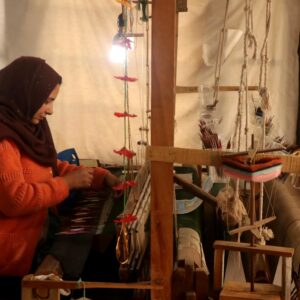
The word pashm means “wool” in Persian, but in Kashmir, pashm referred to the raw unspun wool of domesticated Changthangi goats. In common parlance today, pashmina may refer either to the material or to the variant of the Kashmir shawl that is made from it. Samples of wool fibres discovered from corroded copper artifacts from...
Category: Kashmir
Photo Essay: Kani Shawls
A Kani shawl is a type of Kashmir shawl originating from the Kanihama area of the Kashmir valley. The shawls are woven from pashmina yarn. The government of Jammu and Kashmir has granted a geographical indication to the Kani shawl, making it illegal to sell shawls made outside of the Kanihama area as Kani shawls....
Photo Essay: Tilla Dozi (Tilla Dori)
Tilla is one of the most exquisite forms of embroidery in Kashmir. It is extensively used to decorate ethnic wear with the help of silver, golden, and copper metallic threads. The threads are delicately tied by needlepoint over the fabric to create exquisite designs. Tilla is a traditional craft of Kashmir which is used to...
Photo Essay: Sozni Embroidery
Sozni is a popular needle point embroidery technique from Kashmir valley. It is usually practised by the local craftsman in a home-based workshop called Karkhanas. Most of these are located in Central Kashmir’s Budgam district. In the local dialect, the craft is also referred to as Sozni Kaem, Kani Sozni or setchzinikaem. To make a...
Photo Essay: Aari work- dyeing process. Part 2
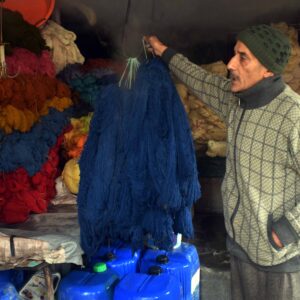
Process of dyeing of aari thread staple: 70 year old Bashir Ahmad works in his family owned, 122 years old dyeing karkhana at Bohri Kadal, Srinagar. Bashir is among the last hand-dyers or Rangrez in Srinagar who continue to manually dye silk and woollen threads especially for aari embroidery. Bashir started working at the karkhana...
Photo Essay: Aari work (Aari kaem), Part 1
Embroidery is more than a craft to the Kashmiri craftsman; it is an emotion woven into threads over a period. The craftsman does just everything from the collection of the finest raw material to thread selection best suited as per the required fabric count. The higher the count, the finer the yarn is and the...
Photo Essay: GR8 Batting
31-year-old Fawzul Kabeer is a young entrepreneur from Kashmir. He has made his mark in the international market for his GR8 willow bat industry, whose bats are being used by many of the top national and international cricket teams. Kabeer’s story has been one of hard work. It took his one and a half years...
Photo Essay: Winter dried vegetables – Hokeh Seun
Before the onset of harsh winters (chillai kalan) in Kashmir, every house would have vegetables strung on the windows or balconies of their houses, to be sun-dried. These can still be seen in a few houses in the Downtown area. In olden times harsh winters severely restricted people’s movement. As there wasn’t any agricultural activity...
Photo Essay: Phae’rie, the smoked fish of Kashmir
The smoked fish delicacy from Kashmir, is getting rarer with each winter. When autumn ends and winter begins, stacks of dry grass start piling up in Soura, Srinagar, along the Anchar lake. Soura, a locality of Srinagar is located at the edge of Anchar lake. Soura is famous for Sher-i-Kashmir Institute of Medical Sciences, a...
Photo Essay: Arq-i-Gulab Waan
Srinagar’s ‘Arq-i-Gulab Waan’, the last surviving rose water distillery in Kashmir, is located near Khanqah-e-Moula in Downtown. The 102-year-old shop is owned by the 66-year-old Abdul Aziz Kozgar. A man of few words, Kozgar’s rose water distillation process is a closely guarded family secret of nearly 500 years. Kozgar’s shop was opened around 1820 by...