
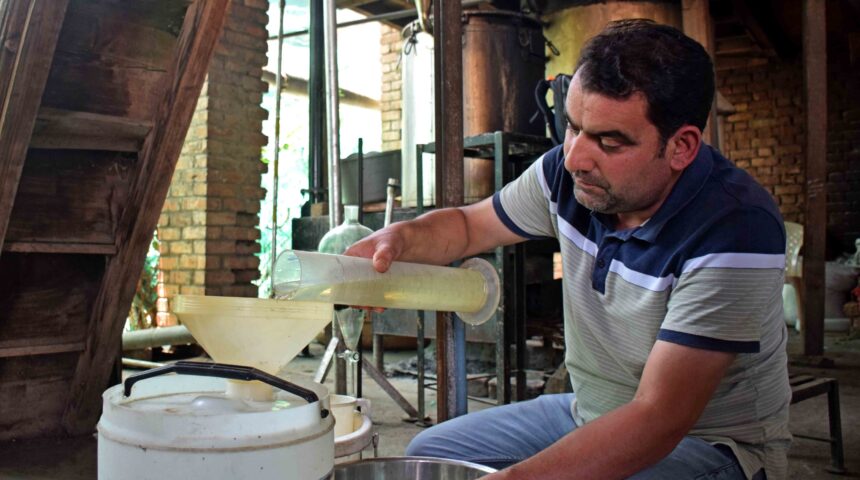
In 1970, lavender was brought to Kashmir from Bulgaria by Dr Akhtar Hussain, the then Scientist In-charge of the Field Station and founder Director of the Central Institute of Medicinal and Aromatic Plants (CIMAP), Lucknow. He introduced lavender cultivation at Field Station Pulwama which is about 35 km south of Srinagar. Although lavender was also introduced in Himachal Pradesh, Tamil Nadu, and other northeastern states, excessive rainfall during the flowering period hindered its expansion in these areas. According to Dr Abdul Sami Shawl after extensive efforts on varietal improvement, a new variety of lavender was developed and its large-scale cultivation began...
Blog
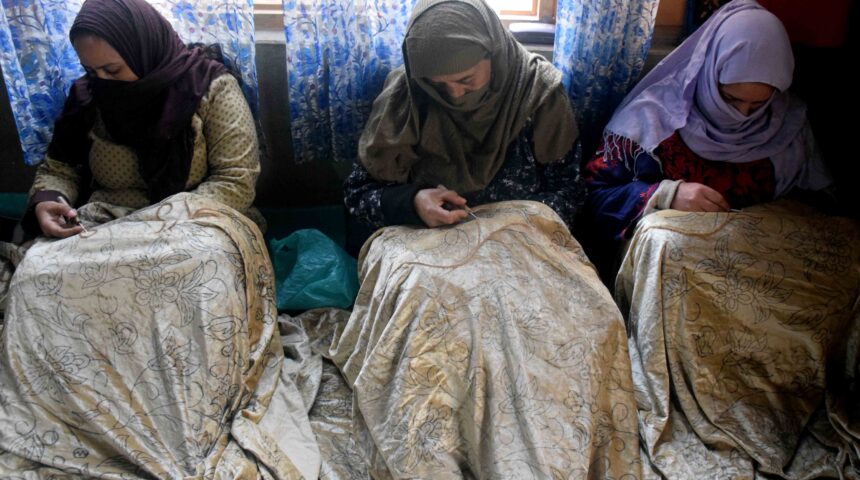
Photo Essay: Crewel Embroidery of Kashmir
Crewel work is a hand-embroidery technique traditionally done in Kashmir, with a hook (aari) and mostly on woolen yarns in single or 2-ply with colours ranging from white to multi-coloured. Crewel Embroidery is usually done on bolts of fabric in varying widths – 56″ wide dusooti cotton manufactured locally in Kashmir being the most common. Fabric bolts may be 20 to 33 yards in length, although custom orders at times require longer yardages per bolt. Crewel embroidery, or crewelwork, is a type of surface embroidery using wool. A wide variety of different embroidery stitches are used to follow a design...
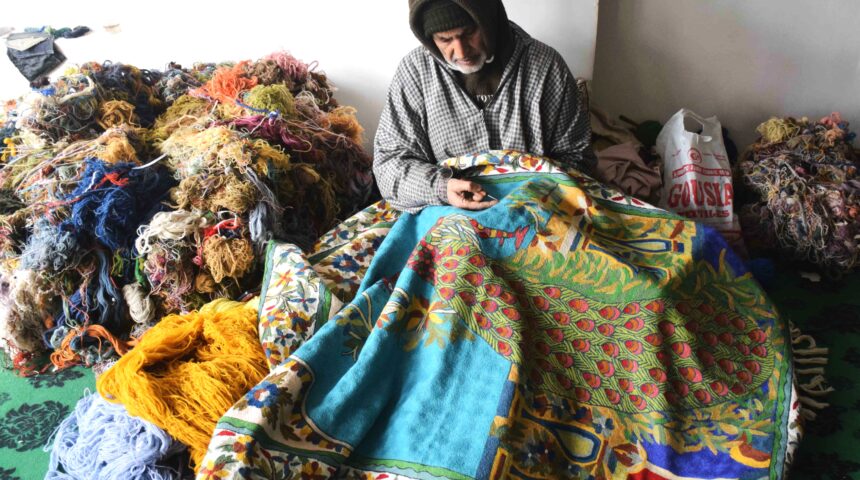
Photo Essay: Kashmiri Chain Stitch
Abdul Rashid Bhat, the 60-year-old chain stitch master from Tengpora, Nawa Kadal, Srinagar has long been associated with this form of embroidery. His works range from life-like designs to abstract patterns in black and white and in rich hues. Chain stitch is a sewing and embroidery technique in which a series of looped stitches form a chain-like pattern. Chain stitch is an ancient craft – examples of surviving Chinese chain stitch embroidery worked in silk thread have been dated to the Warring States period (5th – 3rd century BC). Handmade chain stitch embroidery does not require that the needle pass...
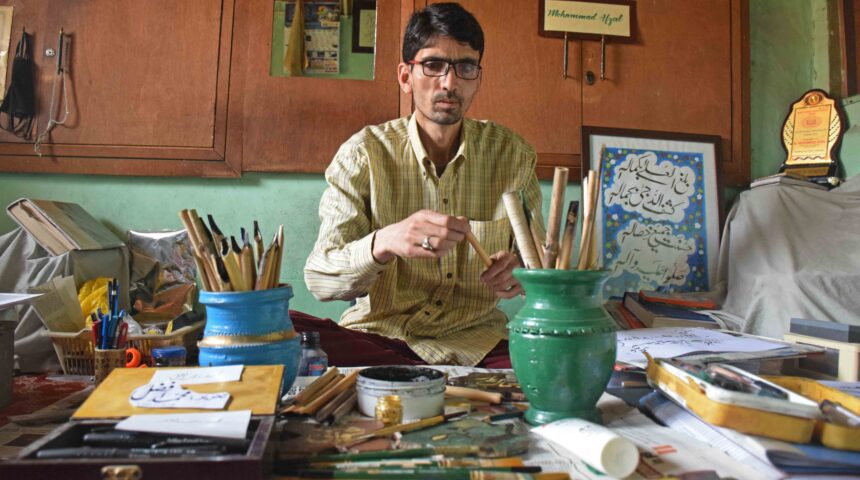
Photo Essay: Kashmir’s Traditional Calligrapher
Mohammad Afzal, 40 of Zadibal, Srinagar is a renowned calligraphy artist. His calligraphy began from the time he began writing on slate as a child. His father would ask him write verses. He learnt the intricacies of calligraphy at an Academy of Art, Culture and Languages, where he continued to work and taught students the art. He learnt the art from the master calligrapher Kousar from Ishber area. Unlike many others who have switched to modern tools, Afzal continues to use the Narkaer Kalam – the Okk Wooden Narkat. Now he trains interested youth every Friday at Baitul Meeras, Aali...
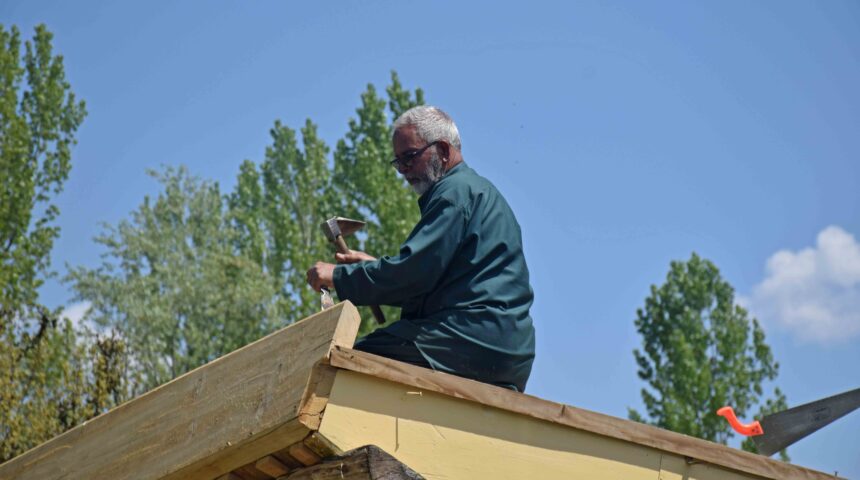
Photo Essay: Kashmir’s only surviving houseboat-maker Abdul Khaliq Najar
70-year-old Kashmiri craftsman, Abdul Khaliq Najar, has spent his life making and repairing houseboats in the Valley. He is the seventh generation in his family who were engaged in construction of houseboats. Najar is the only person alive among the ones who were known for their mastery in the making of houseboats, which attract tourists from around the world in Dal and Nigeen Lake. Najar has for decades made a living out of repairing and building new houseboats. However, he is currently in despair given the dwindling work due to dire shortage of deodar wood, used in houseboats. Najar has...
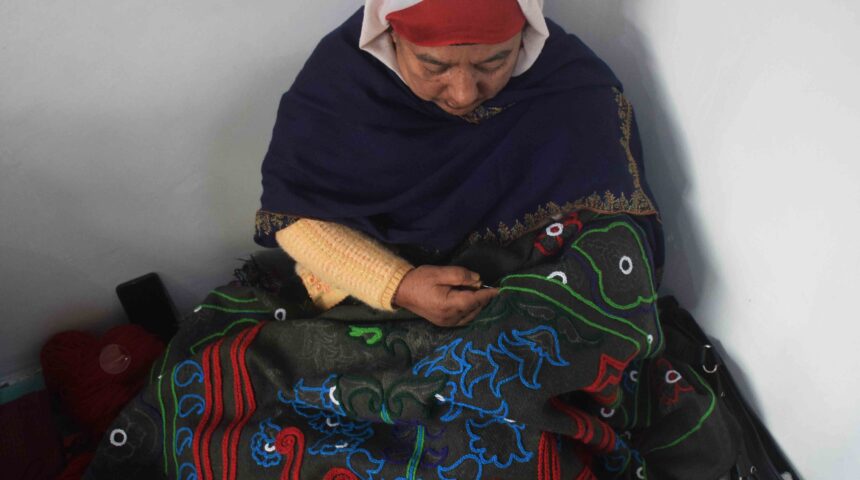
Photo Essay: ‘Gabba’- Kashmiri woollen rugs
Making of Gabba’ (Kashmiri rug embroidered with aari work) has been carried out since the late 16th century Mughal period. Gabbas are made up of wool blankets. The old blankets are dyed in vegetable colors and with a cotton backing. These can also be made new by mixing wool (one or two ply) and a small quantity of cotton. Gabba was used to keep warm during long and harsh winters. The Gabba ranges from five to seven feet. Then Nakashi (design) are stamped on these raw blankets. These are then embroidered with thick coloured threads. Gabbas are made in different...
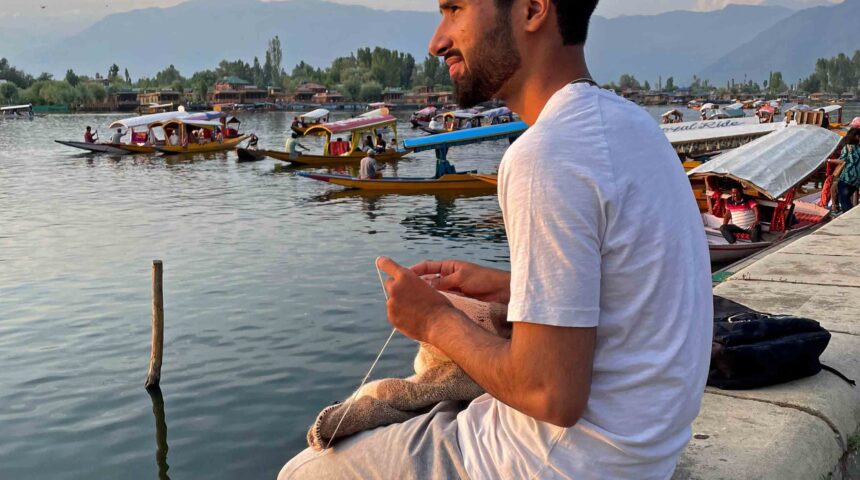
Photo Essay: Breaking Gender Barriers with Crotchet
An English Literature student from Srinagar’s Sher-e-Khas, Nazar Nasir Naik has been breaking stereotypes with his crocheting. Nazar, known as “Male Crocheter of Kashmir”, took a liking to the craft art during an unrest in 2016 when his aunt was knitting a sweater. He infused a new life in the orthodox style of knotting with his innovative and stylish crochet products, which are creative masterpieces. He feels that one has to always work around the traditional designs to create a new attractive product line. For people in Kashmir, this craft is traditionally reserved for the women folk. But it is...
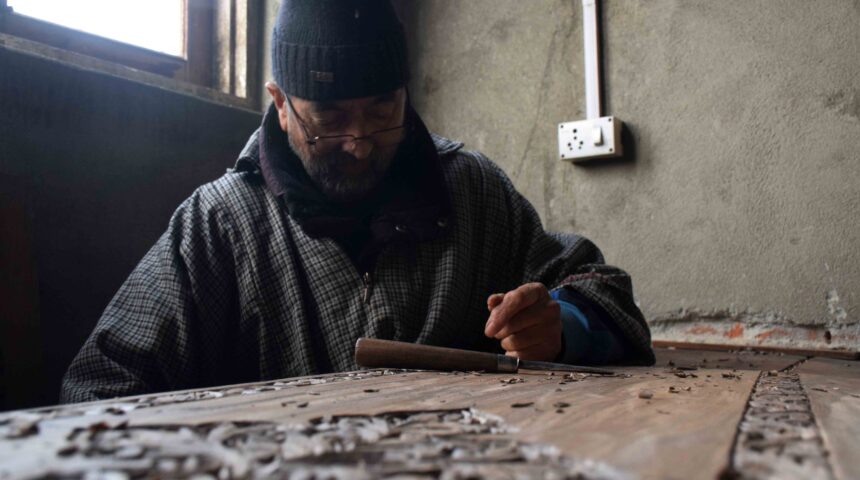
Photo Essay: Walnut wood carving, Kashmir
Walnut wood carving is an ornamental and delicate craft process that is unique to Kashmir due to the concentration of walnut trees in this region. The raw material used for the fine woodcarving of Kashmir is obtained from walnut tree locally known as Doon Kul (Juglans regia tree) and is cut only once it matures to an age of 300 years. Walnut trees are of four varieties namely; Wantu or Vont Dun (fruit has hard shell), Dunu and Kakazi or Burzol (best fruit with lightest shell), which are cultivated while the Khanak is found in the wild. Like most other...
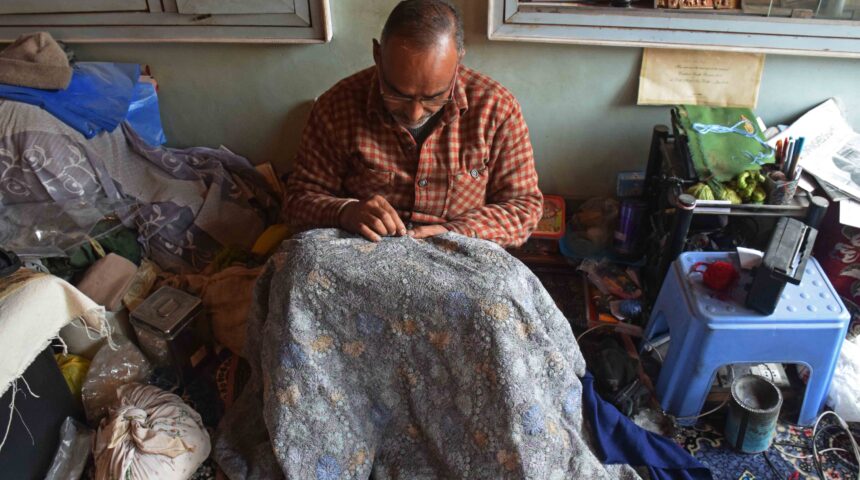
Photo Essay: Sozni artist of the Valley
Ghulam Mohammed Beigh, a 70-year-old sozni artisan from Zadibal, Srinagar has been embroidering Pashmina shawls from the last 40 years and continues to do so with his children to keep the glorious craft alive. Beigh grew up in a family of artisans, where his father, grandfather and uncles all were associated with Pashmina embroidery. Every member of this family is a state or national award winner. “I believe that my kids and their kids will continue to inherit this art from us even after my death, but I cannot be sure of this. The younger generations lack patience which is...
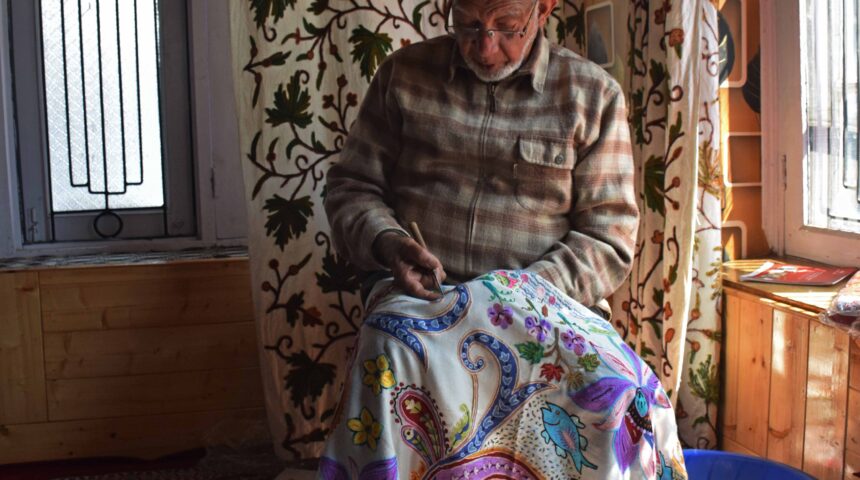
Photo Essay: Aari staple by master artisan Mir Abdul Majeed
80 year old Mir Abdul Majeed, of Kalai Andar area of the old city of Srinagar, is an award winning aari embroidery artist from Kashmir. Aari staple or hook-work is a common form of embroidery, taken to another level by master artisan Mir Abdul Majid with his landscape embroidered pieces. One of his landscape works of the Srinagar city’s Hari Parbat fort was even kept as a souvenir by former Prime Minister late Indira Gandhi and he went on to receive the state award in 2017 for his contribution to the art. He has written verses of Holy Quran, Urdu...
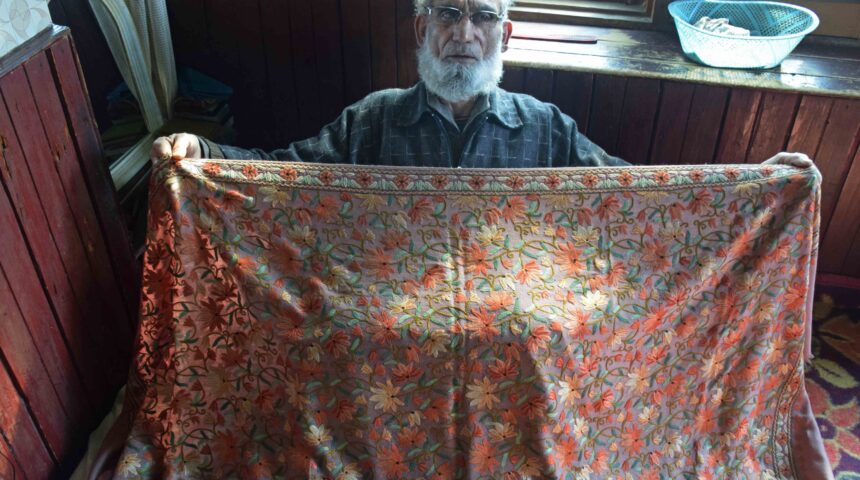
Photo Essay: Kashmir’s last staple artisan
Ghulam Rasool Sofi, aged 65,is probably one of the last few Kashmir’s staple artisans. Born into a lineage of artisans, he has dedicated his life to this handiwork. His craft has reached as far as Spain and America. However, he now feels that the onslaught of mechanised mass- produced goods has eroded the demand for handmade artifacts, though these can never be replaced or replicated by machines. ‘Aari’ staple or hook-work is a common form of embroidery in Kashmir. In Kashmir it is done on Pashmina or wool, with either single ply or double ply wool yarns. ...
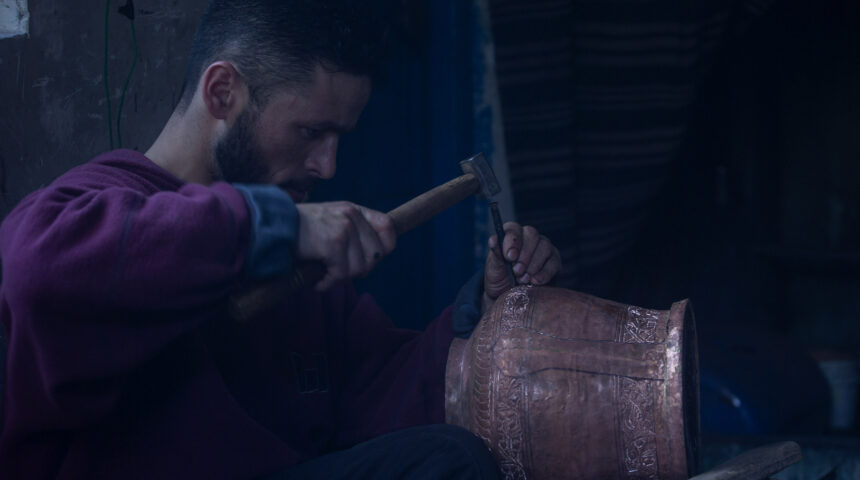
Photo Essay: Kashmiri Kandkari Work
Copper vessels have been used traditionally in Kashmiri households for cooking and serving meals. Copperware known as Traam has been an indispensable commodity in Kashmir since ages. The household utensils include lota (pot), Tream (plate), naer (water jug), tash- naer (for washing hands), samovar for preparing tea, dishes, bowls,trays ,vessels, Lamp Shades and many more. The crafting of coppeware involves various skills at different stages, such as those of: khar (smith), naqash (engraver), zarcod (gilder), roshangar (polisher), and charakgar (cleaner or finisher). In past there were special localities or Mohallas like Roshangar-Mohalla were named after these professions,(however now the tale...