

Walnut wood carving is an ornamental and delicate craft process that is unique to Kashmir due to the concentration of walnut trees in this region. The raw material used for the fine woodcarving of Kashmir is obtained from walnut tree locally known as Doon Kul and is cut only once it matures to an age of 300 years. Wood used for carving can be from the root or trunk of the tree. The wood derived from the root is almost black with the grain more pronounced than the wood from the trunk, which is lighter in color. Branches have the lightest color with no noticeable grain. It is actually the dark part of wood, which is best for carving as it is strong. The value of the wood differs with the wood from the root being most expensive. Walnut trees are of four varieties namely; Wantu or Vont Dun (fruit has hard shell), Dunu and Kakazi or Burzol (best fruit with lightest shell), which are cultivated while the Khanak is found in the wild. These can be cut only once they mature to give fruits.
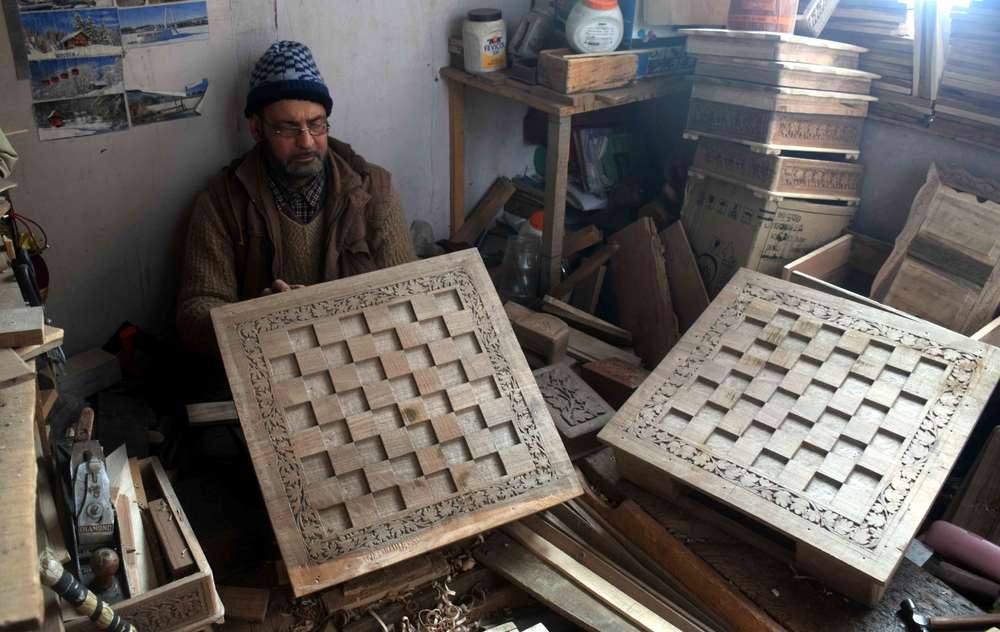
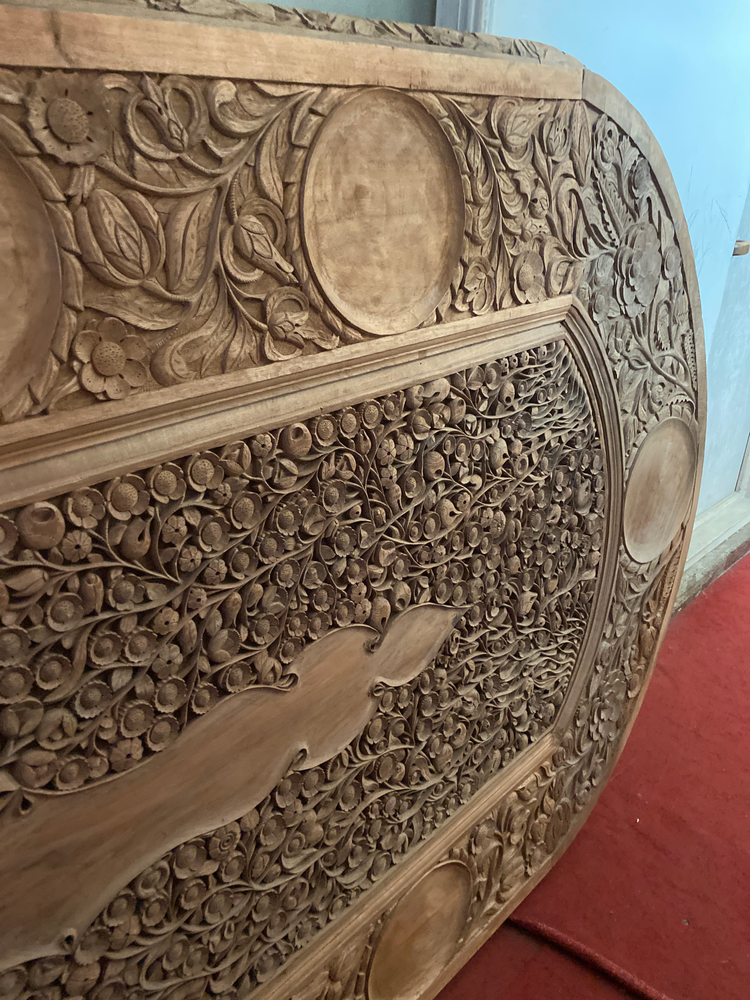
The naqqash, master carver, first etches the basic pattern on to the wood and then removes the unwanted areas with the help of chisels and a wooden mallet so that the design emerges from the walnut wood as an embossed surface. The carving of furniture and smaller items is an elaborate process and involves high degree of skill and craftsmanship.
There are five main styles of woodcarving: Undercut (Khokerdar), Open or Lattice work (Jalidahr), Deep carving (Vaboraveth), Semi carving (Padri), and Shallow carving (Sadikaam). The processes involved in walnut wood carving are joinery or carpentry, carving, and polishing, each with their own expert artisans.
The traditional tools being employed are:- chisels of different type (wathlavun), planer (randha), measuring tape (phet gaz), L-angle for obtaining parallel and perpendicular lines (khari hat) and Wooden scale (khat chhal). The motifs on the wooden artifacts are inspired from the various natural wonders of Kashmir, Chinar leaves, Vine leaves,flowers like Lotus and Rose.
Walnut woodcarving is believed to have been introduced in Kashmir by Sheikh Hamza Makhdoom during the reign of Zainul Abdideen in the 15th century. The king promoted the art to improve the valley’s economy.
The craft was initially restricted to the creation of elaborate palaces and houses. Written records tell of Zain-ul-Abadin`s great razdani, palace, and its elaborate wood carvings. To this date, several fine examples of intricately carved buildings, shrines and mausoleums survive in Kashmir.
The city of Srinagar is the center of wood carving art. Walnut wood karkhanas are found in the heart of Srinagar, where master carvers lean over the wood, chiseling and polishing.
Ghulam Nabi Hakak, 76, is perhaps one of the oldest artisans still working with his chisel. Born at Nawa Bazar in 1946, Hakak said he wanted to study but financial constraints led him to drop-out. One of my father’s friends took him to his son-in-law who was a wood carver and became his first teacher in wood carving.
The other workshop is of Ghulam Nabi Dar, 70, a master wood carver. When Ghulam Nabi Dar Dar was six years old he was admitted to a private school in his neighbourhood. But soon his father couldn’t afford the expenses and he had to drop out when he was just 10. Most of the time he was without fees, uniform and books. Education became unaffordable.
To help the family come out of its financial crisis, Dar’s maternal uncle took him to the kharkhana of a local wood carving artisan Abdul Razzaq Wangnoo. Dar along with his younger brother, Abdul Majeed Dar, started working for him. He was not paid for two years while learning the craft and doing menial tasks. In the following three years, he was paid two and a half rupees. His father insisted that both the brothers learn the craft properly even if they were paid less. They then joined another artisan, Abdul Aziz Bhat, to further enhance their skills. It was eventually from their master Nooruddin that he learnt the finer skills.He opened his own workshop in late 1970s and is now one of the most celebrated artisans of the region. Besides his regular orders of windows etc, he crafts his own designs which are displayed in one of the rooms of his house, above his workshop. Unfortunately though, few are willing to continue this art, including his own children.






Leave a Reply