

For many years the words embroidery and tapestry have caused a bit of confusion. The word tapestry was originally applied to a fabric where the pattern was woven into the fabric as it was being made. It is a form of textile art, traditionally woven by hand on a loom. Tapestry is weft-faced weaving, in which all the warp threads are hidden in the completed work, unlike most woven textiles, where both the warp and the weft threads may be visible.Embroidery is the ornamentation of a fabric using a needle and thread. For many years now, the word tapestry has also been commonly applied to canvas work. The word embroidery initially had only a small application, but this has been expanded to mean many different fabric ornamentation either using a needle or machine.
Although there are many stitches that may be used in either type there are, broadly speaking, basically two main types of embroidery: free or surface work and counted thread work. Tapestry/needlepoint is a form of counted thread embroidery in which thread is stitched through a stiff open weave canvas with a tapestry needle. Most tapestry/needlepoint designs completely cover the canvas and can be worked in a variety of stitches and patterns. Canvas is selected based on the mesh size – the number of holes per inch of canvas – and threads selected for a tapestry/needlepoint project are based on the mesh count. Thicker threads such as tapestry wool are used for canvases with lower mesh counts and finer threads are used for canvases with higher mesh counts.
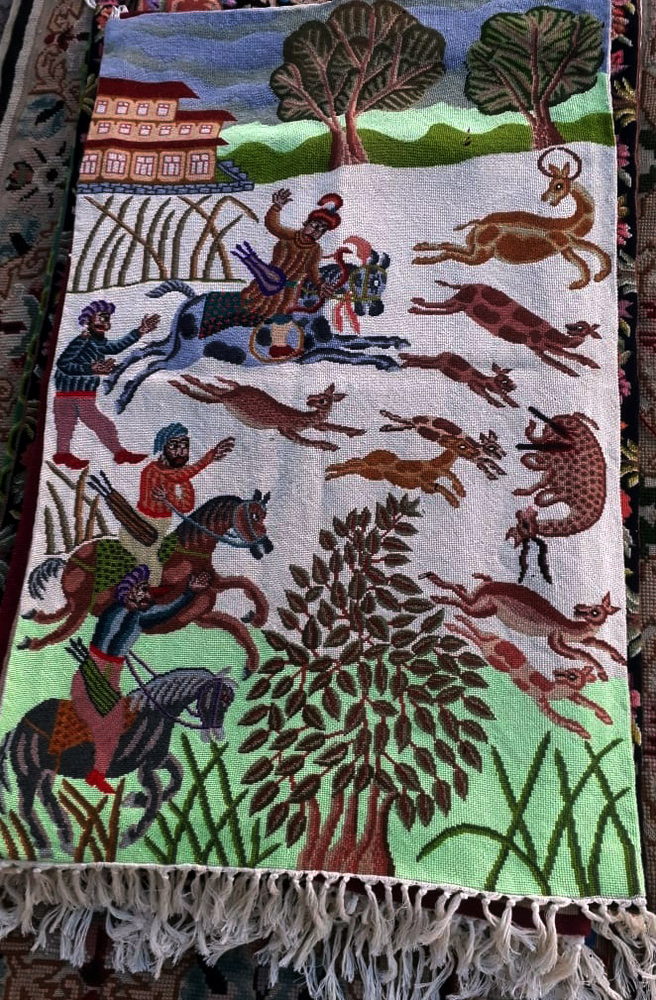
In Kashmir, the embroidered textile art is generally referred to as tapestry. Design on paper is transferred to a stretched canvas for needlework, which is usually cross-stitch.
Mohammad Hussain Mir, 61, is an artisan from Fateh Kadal area of Srinagar city who has been associated with this craft from his 20s. He learnt this art from his father and grandfather. It is believed that this embroidery art came to Kashmir from France in the 1930s. The locals who got trained in this art later opened their own workshops. He and his brother Mehraj-Ud-Din are among the last remaining tapestry artists of the Valley. During Sheikh Abdullah’s reign all the crafts, including tapestry, were revived and artisans were provided with full support, says Hussain. Now they are They’re imparting skill training to the young generation under the Karkhandar scheme—providing a forum for people to study Kashmiri handicrafts.




Leave a Reply