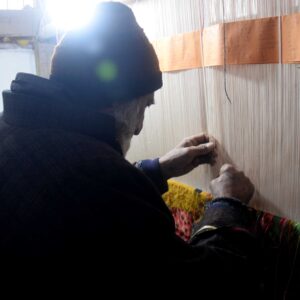
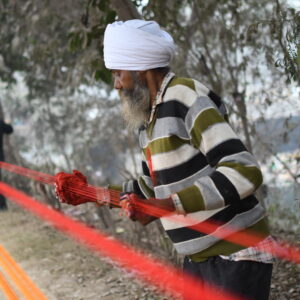
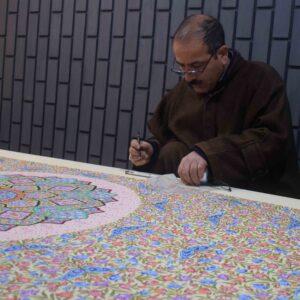
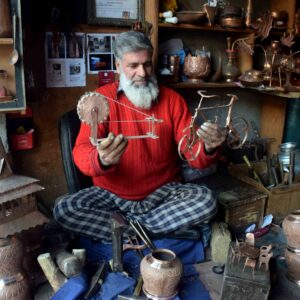
Kashmiri carpets are the hand-knotted categories of carpets and are made by tying knots. These carpets are made in a karkhanas where the skilled weavers work. The origin of hand knotted carpets locally known as Kal baffi dates back to the 15th century and is said that the skilled craftsmen were brought to Kashmir by...
Category: Uncategorized
Photo Essay: Pashmina carpets
Shahnawaz Ahmad Sofi, son of Gul Mohammad Sofi, a resident of Rathpora Eidgah Srinagar, completed his graduation in 2003 from the Institute of Music and Fine Arts and used to make portraits and was passionate about colours. After his graduation he took up his old family business of carpets (since 1950s) and decided to revive...
Photo Essay: Nuno Silk Scarf
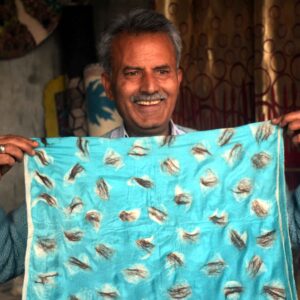
Farooq Ahmed, of downtown Srinagar, who has mastered the fusion art of the traditional making Kashmiri Namda with nuno felting has taken it a step further to create silk scarves with nuno felting technique. Farooq Ahmed is the only artist in India who has merged these two techniques to produce Namdas, silk scarves etc. It...
Photo Essay: Namda and Nuno Felting
Kashmir has been known for its Namda rugs made of sheep wool, which came in to Kashmir from Central Asia. Kashmiri Namda rugs are non-woven rugs developed by highly skilled artisans in Kashmir using the felting technique. These floor coverings are primarily made of pure sheep wool, as wool has a natural property to felt....
Photo Essay: Jalakdozi Namda
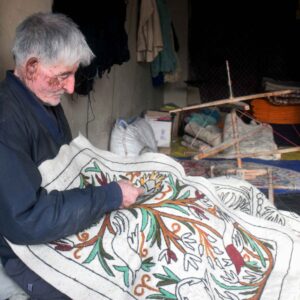
Chain Stitch, known as Jalakdozi in Kashmiri is a chain stitch embroidery done on rugs called Namda made of sheep wool. Namdas came in to Kashmir from Central Asia, however, there was a locally crafted rug called gabba, an embroidered Kashmiri rug. Made by re-purposing old woollen blankets and waste cloth, a gabba is used...
Photo Essay: Harissa, the satiating winter morning dish.
Harissa, not to be confused with the hot red chilli pepper paste (another version is with rose petals) of Maghreb (Tunisia, Morocco, Algeria and Libya), is a winter breakfast dish of Kashmir, perhaps more of just Srinagar. A few dozen harissa shops, mainly in old Srinagar, the downtown area or the Shehar-e-Khaas, begin a routine...
Photo Essay: Tying the Punjabi Pagg
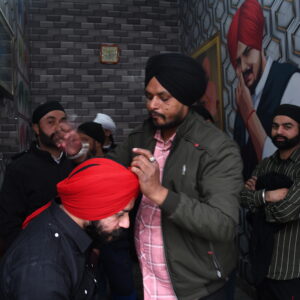
Vikramjit Singh (Vicky) of Amritsar has been tying turbans for the last 12 years. What started as a hobby became his profession over the years. On an average he ties turbans for 40-50 people daily. These people of mixed communities tie turbans for various occasions, including weddings and also just out of interest. Vicky can...
Photo Essay: Dor making tradition of Punjab
Kite (patang or guddi in Punjab) flying has been one of the major cultural activities for the people of the Subcontinent, especially of Punjab. Kite flying is popular on Lohri and Baisakhi. Kite flying festivals and competitions were popular even before and during the time of Maharajah Ranjit Singh and remained so in undivided Punjab,...
PhotoEssay: Art of Papier Mache, Kashmir
Kashmiri papier-mâché is a handicraft of Kashmir based primarily on paper pulp, and is a richly decorated, colourful artifact; generally in the form of vases, bowls, or cups (with and without metal rims), boxes, trays, bases of lamps, and many other small objects. These are made in homes, and workshops, in Srinagar, and other parts...
Photo Essay: Copper innovator, Srinagar
Near the historic Khanqah-e-Moula in Srinagar, is a small shop of copper ware of artisan Mohammad Aslam Bhat. Named Vanposh, the shop has a unique collection of copper items like a spinning wheel (yender in Kashmiri), beautifully handcrafted clocks, table lamps and other creative items made of copper. Bhat learnt the craft from his maternal...