

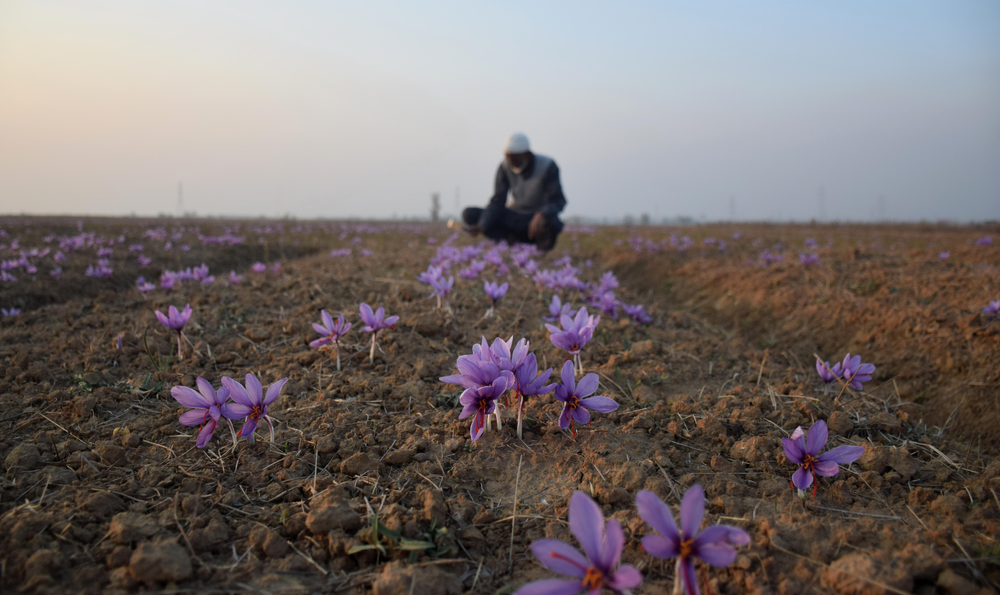
With more than 20,000 households engaged in saffron farming, Pampore, a tiny town 14 kilometres from Srinagar, is referred to as the ‘saffron capital of India’. The saffron grown in the area is of the highest quality and sells for up to Rs 250,000 per kilogram, for which approximately 150,000 flowers are required.
Grown in Kashmir at an altitude of over 1,600 meters, saffron is tightly woven into the local economy, with more than 20,000 families engaged in related businesses, mostly in the districts of Pulwama, Srinagar and Budgam. The prized spice is extracted as threads from the stigma and style of the flower.
There are conflicting accounts about how the spice came to India, while some say that it came from Persia, other historians say saffron or Zafran (kesar/ kong posh in Kashmiri) has been cultivated in Kashmir since at least 500 BC.
According to Kashmiri legend, two Sufi saints of the 12th century, presented a local chieftain with a saffron crocus bulb after he cured them of an illness. There is a golden-domed shrine and tomb dedicated to the saints in the saffron-trading village of Pampore.
The harvest time for saffron is around November. On the first day of the harvest, saffron farmers head to the shrine of Hazrat Sheikh Sharif-ud-Din in Namblabal Pampore to offer some saffron.
Kashmiri Saffron is considered to be of the highest quality because of the high amount of crocin in it. Crocin gives colour and medicinal properties to saffron. The amount of crocin in Kashmir’s saffron is 8.72 per cent, while the same amount in Iran’s saffron is 6.82 per cent.
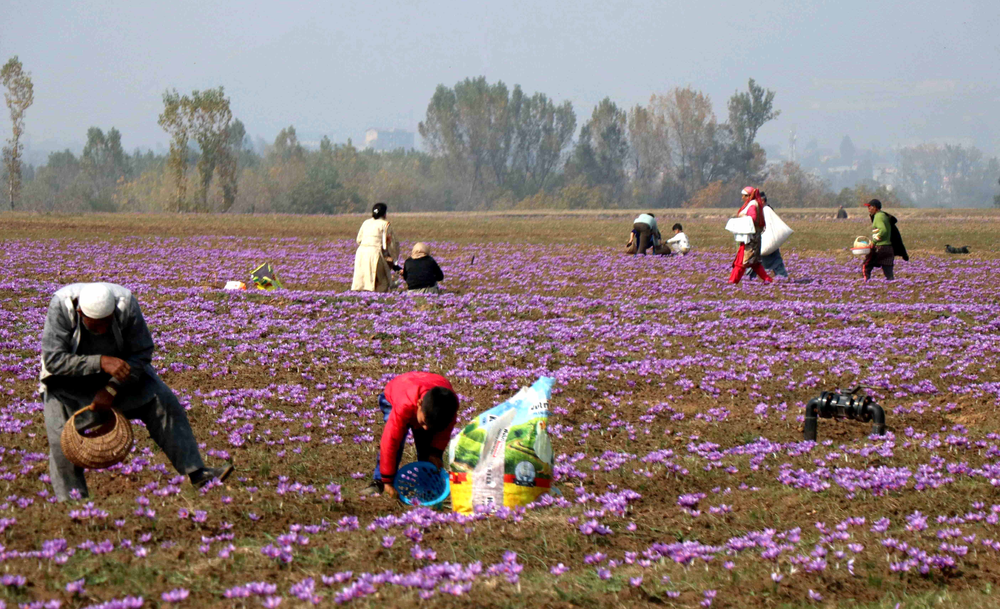
Saffron grows on the karewas of Pampore. During harvest season, men, women as well as children perform the tasks of plucking the saffron flowers, hand-picking and placing the crop on white cloth, and drying the stigma and stamen (only the red part is used). In Pampore, more than 16,000 families are directly dependent on saffron for their livelihood. According to 2011 census approximately 11,000 women in the Kashmir Valley are associated with the saffron farming sector.
In Kashmir three varieties of saffron are found: Lachha Saffron, Mongra Saffron and Guchhi Saffron.
Over the past two decades, the production of saffron has reduced considerably. According to saffron growers and agricultural experts, climate change, poor irrigation, failure of the National Saffron Mission, political instability, pollution caused by adjoining cement factories, traditional farming practices, urbanisation and imports of the cheaper Iranian varieties of saffron pose a threat to the future of the cash crop. Official figures reveal that saffron crop was being cultivated on 5707 hectares of land at Pampore in 1996, which had shrunk to around 3500 hectares by 2017.
In 2010, the central government launched the National Saffron Mission to revive production and study new cultivation methods. The government has also opened a Saffron Trading Centre in Pampore with high-tech post-harvesting facilities. In 2020, Kashmir-grown saffron was given the Geographical Indication, a designation that, by certifying its origin, helps protect it from adulteration and enables farmers to fetch higher prices. However, many growers argue that the GI tagging has been provided only to the saffron produce which goes to Indian International Trade Saffron Spice Park Dusso Pampore.





Leave a Reply