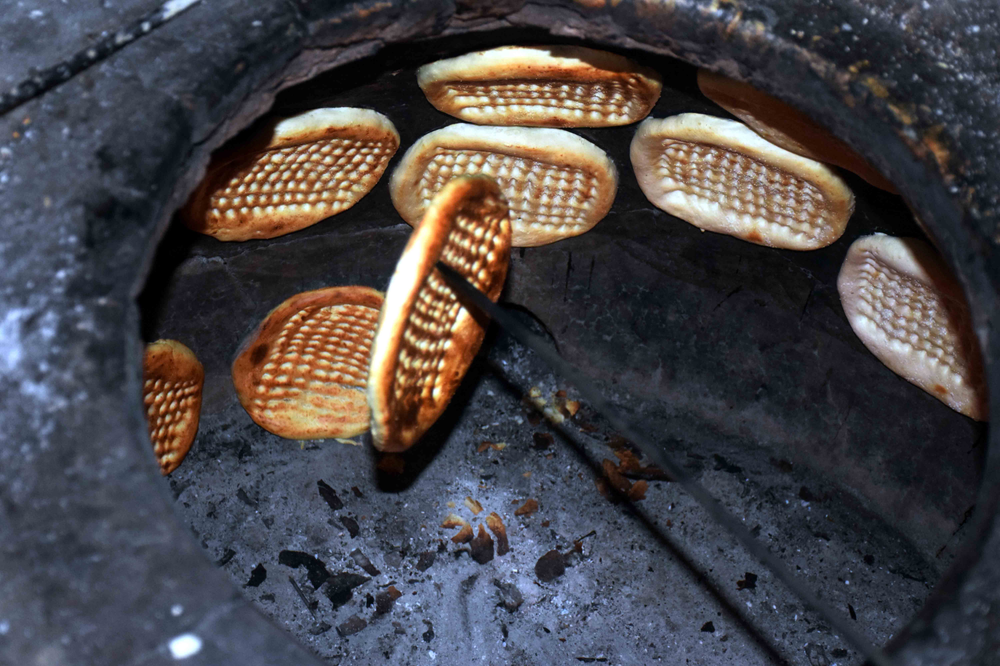
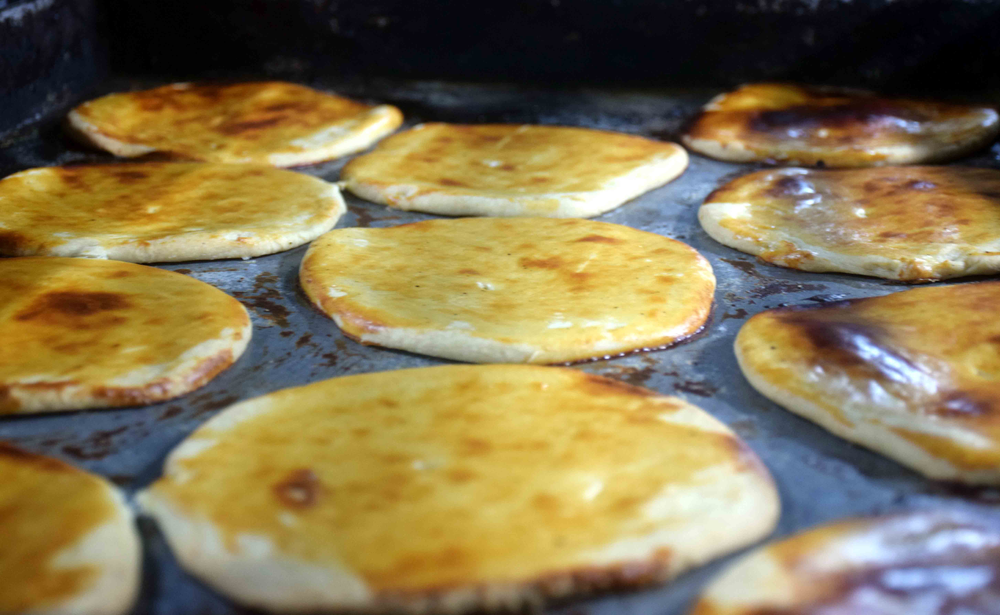
During Ramzan special breads are made such as the Lacha Bagerkhane (Warke Bagerkhane), Makie Wor (Sugar-free Kulcha), Butter Roti, Lawasa, Kripa, Namkeen and Sweet Roti.
The culinary art of baking in Kashmir can be traced to Central Asia, although some might argue that the British introduced it. Kashmir being on the famed ’Silk Route, was influenced by Central Asia. The indigenous bakeries in Kashmir are locally called Kandurs probably deriving its name from the Tandoors (the earliest finds dating back to 2600 BC) used to bake breads such as rotis & naan. A number of bakeries have sprung up in Kashmir such as the ‘Le Delice’ serving French delicacies such as the Croissants, & baguettes, or the ‘Iqra Bakers’ serving hazelnut cakes or the ‘lee Enn’ Bakery famous for the plum cakes, coconut biscuits and Patties. One of the earliest was Ahdoos on Residency Road, famous for its bread like bakarkhani and sheermal and a wide variety of puffs. They are also known for their walnut based treats like biscuits, tarts, and cakes.
While these bakeries cater to western delicacies, the Kandurs continue to make bakarkhani, lavaas, chochwors, kulchas and sheerrmals . Bakery in Kashmir is more than a way of life. For some, it is a tradition passed on from one generation to another. In Kashmir, the Kandur shop isn’t just a place where ones goes to buy the morning and evening breads, it is a social hub. The Kandur forms an intrinsic part of the social life in Kashmir and every locality has its own local Kandur.
Kashmir was a cultural melting pot where traders from China and Central Asia would always make a halt at Yarkand Sarai in Srinagar. Several of the original bakers were Yarkandis (or the Hajims), some survived in Ladakh too, though now mostly all replaced by Kashmiri bakers.
Many historians believe Kashmir’s Nun Chai has Yarkand connection, the city in Turkistan. A similar kind of beverage known as Atkan chai is made with salt, milk and butter in the region. The beverages of Kashmir also find a way into its spirituality. In Kashmir, Samovars of Nun Chai or Kehwa/ kahwa can be seen brewing at its shrines and khanqahs. In most of these shrines on 11th day as per Islamic calendar, cups of Nun Chai with flecks of coconut and Kashmiri bread are relished by the devotees.
In Kashmir, there is bread for every season, occasion and even time of the day. There are two kinds of bakers—the first, who bake in tandoors half submerged in the ground. They produce traditional breads like czot, czachworu, lavasa and bakarkhani. Others work with coal-red ovens to produce a variety of tea-time goodies, like fenis , puffs and kulchas, which are soft, buttery and topped with a layer of poppy seeds. Most of these breads are eaten with Nun Chai. The texture and quality of these breads are determined by the percentage of wheat protein, temperature and type of flour present in the bread.
For every single variety of these breads, the tandoor has to be prepared differently. The temperature varies for each bread. Tchot/Girda is prepared under open flame, to make it soft and get the yellowish brown colour on its surface. Kulchas and Tsochwor are baked at a low temperature after covering the tandoor. Bakarkhani is cooked under medium flame with the tandoor opening covered with warm towel.”
Traditionally, Kashmiris prefer to start their day with two special teas – the Kahwa and the Nun Chai along with an assortment of breads. Tchot/ girda is the most common bread eaten with these teas. Well before dawn, hundreds Kandurs in the Valley fire up wood tandoors to make bread.
Some of the many types of bread baked by the Kandurs are:
Tchot/Czot/Girda/Roti – This is a medium sized everyday bread, had for breakfast with butter or jam. It is golden on the upper side with fingertip indentations and white from below. Some of the bigger versions of Girda are served with ghee or sheep fat along with non-vegetarian dishes at ceremonies.
Ghyev czhot – This is the special kind of roti. It is made in the same way as the Girda with an added ghee to make it extra soft and then cooked in tandoor. It is used for special occasions such as Ramadan and served with wazwan in social functions.
Lavasa/Lawaas – It is a thin, large, unleavened flat bread, white in colour, made of maida. One can also apply butter or jam to lavasa. Barbeques and traditional Kashmiri snacks like masale tchot (masala made with white peas and chutney) are served wrapped in a lavassa.
Tsochwor /Czochworu/chochwor –It is a small, soft round, bagel shaped bread of about three inches diameter and six inches circumference, with a soft upper half sprinkled with sesame seeds or poppy seeds and the lower crust is crispy. It’s the evening/afternoon bread.
Kulcha – unlike the Punjabi Kulcha, the Kashmiri Kulcha is small, dry, crumbly bread, usually round in shape, sprinkled with poppy seeds. They come in two versions- mith (sweet) and namkeen (savoury). These crumbly breads are a perfect accompaniment with some traditional Dodh Kahwa (milk Kahwa). The savoury version is decorated by placing a peanut or an almond in the centre of the upper face of the Kulcha along with a generous sprinkling of poppy seeds. It is consumed on special occasions like weddings, Eid etc.
Anantnag is famous for its, slightly bigger, sweet kulcha or khatai/ Kandi Kulche, while Charar-i-Sharief has one of the best savoury kulchas.
Sheermal/Krippè – usually served with Kahwa. It is dry, crumbly bread with a long shelf life. It is mildly sweet due to the addition of some sugar and milk. This dry brownish yellow bread has a sesame covered top and is prepared from date flavoured milk. The Sheermal made in Pampore town of Kashmir is quite famous for its unique taste.
Katlam – similar to the sheermal, it is crispier and thinner.
Bakarkhani/ Bakerkhani – is a layered variety of bread that resembles filo pastry. The bread is prepared by stretching a sheet of dough repeatedly and rubbing each layer with a generous scoop of ghee before baking till crisp in a tandoor. It is the local custom to send trays full of large size Bakarkhanis to the in-laws after occasions like child birth or engagements alongside fried chicken platters. There is another type of Bakarkhani, in which halwa is rolled and served, called a paratha and is sold at Sufi shrines and distributed on Urs or at a religious community gathering.
Roth/ Roath (Kashmiri Dry Fruit Cake) – is a very large bread usually one-meter long, two and a half meter wide baked and garnished with dry fruits and silver foil. It holds its importance during weddings and is sent as a gift from the bride’s side which is called Roth Khaber, to be distributed among family members. The main ingredients that go into a roath are wheat, sugar and ghee along with black cardamom seeds and poppy seeds that add a unique flavour to it. One can find this in the Hazratbal market.
Some other breads found in Kashmir, which are usually made at home and may not necessarily be baked in the tandoors.
Makai Woer – resembles a traditional Tsochwor in shape but is a bit more flattened. It’s the evening/afternoon bread prepared from corn flour.
Makai Tchot – is a flat, levelled Kashmiri bread made from corn flour. This chapatti like bread is made on a tawa instead of tandoor. It is an important part of the rural Kashmiri cuisine.
Tomla tchot is again flat, levelled Kashmiri bread made from rice flour, on the tawa. It is an important part of the rural Kashmiri cuisine and a must with nun chai.
Pulke or Chapati made of whole wheat is cooked on a tawa.
Aab Tchot is a type of pancake similar to Dosa made from rice. It is relished with Nun Chai in villages across Kashmir.
Porathe is a huge flat bread, with no stuffing inside it resembles Poori but is almost seven times its size. Sold across Kashmir outside Sufi shrines it is taken as a quick snack with sweet semolina Halwa. A Porathe weighs upto 1-kg, enough for an entire family on a day out.