A spinning wheel is a device for spinning thread or yarn from fibres. It was fundamental to the cotton textile industry prior to the Industrial Revolution. It laid the foundations for later machinery such as the spinning jenny and spinning frame, which displaced the spinning wheel during the Industrial Revolution.
The basic spinning of yarn involves taking a clump of fibres and teasing a bit of them out, then twisting it into a basic string shape. The spinner continues pulling and twisting to make it longer and longer, and to control the thickness. Thousands of years ago, people began doing this onto a stick, called a spindle, which was a very lengthy process.
Arnold Pacey and Irfan Habib propose the spinning wheel was most likely invented in the Islamic world by the early 11th century. There is evidence pointing to the spinning wheel being known in the Islamic world by 1030, and the earliest clear illustration of the spinning wheel is from Baghdad, drawn in 1237. The spinning wheel spread from the Islamic world to Europe by the 13th century, with the earliest European illustration dated to around 1280. In France, the spindle and distaff were not displaced until the mid 18th century. In India the earliest reference is found around the 12th century.
The ubiquity of the spinning wheel has led to its inclusion in the art, literature and other expressions of numerous cultures around the world, and in the case of South Asia it has become a powerful political symbol. Sun Charkhe Di Mithi Mithi Kook is a Punjabi folk (Sufi) song inspired by the traditional spinning wheel. It is an ode by a lover as she remembers her beloved with the sound of every spin of her charkha. There are several folk tales, songs and art, around the world, which revolve around the theme of the charkha.
Numerous types of spinning wheels exist, including:
-
- the great wheel also known as walking wheel or wool wheel for rapid long draw spinning of woolen-spun yarns;
-
- the flax wheel, which is a double-drive wheel used with a distaff for spinning flax fibres for making linen;
-
- saxony and upright wheels, all-purpose treadle driven wheels used to spin both woolen and worsted-spun yarns; and
-
- the charkha, native to South Asia.
The word charkha, which has links with Persian charkh, wheel, is also related to the Sanskrit word for circle chakra. The charkha, a small, portable, hand-cranked wheel, is ideal for spinning cotton and other fine, short-staple fibres, though it can be used to spin other fibres as well.
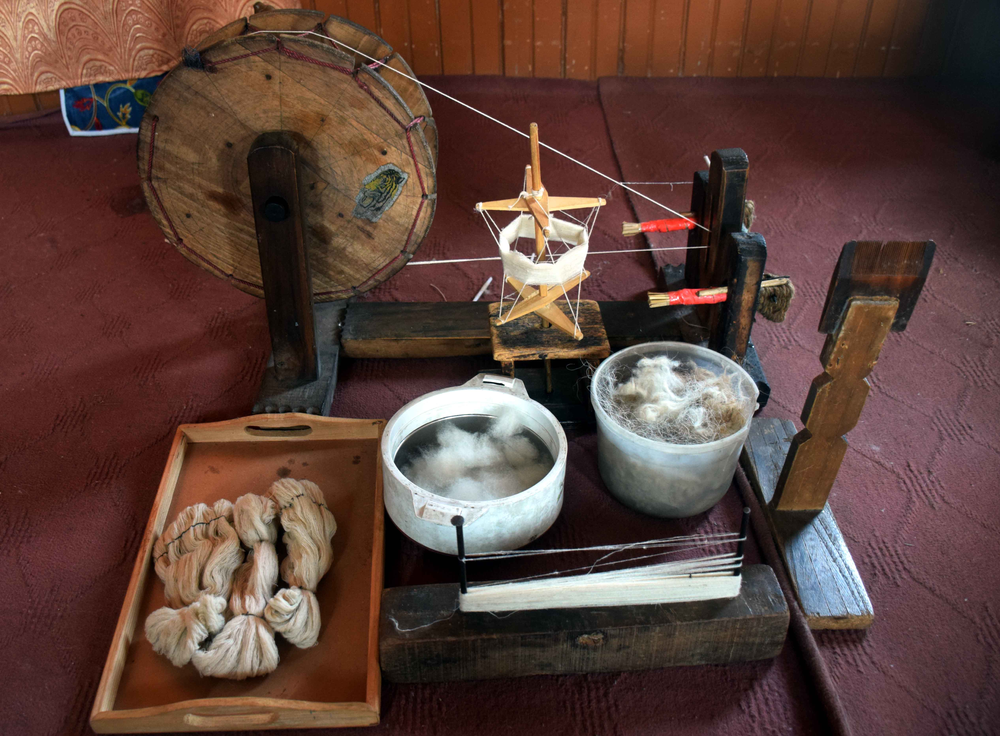
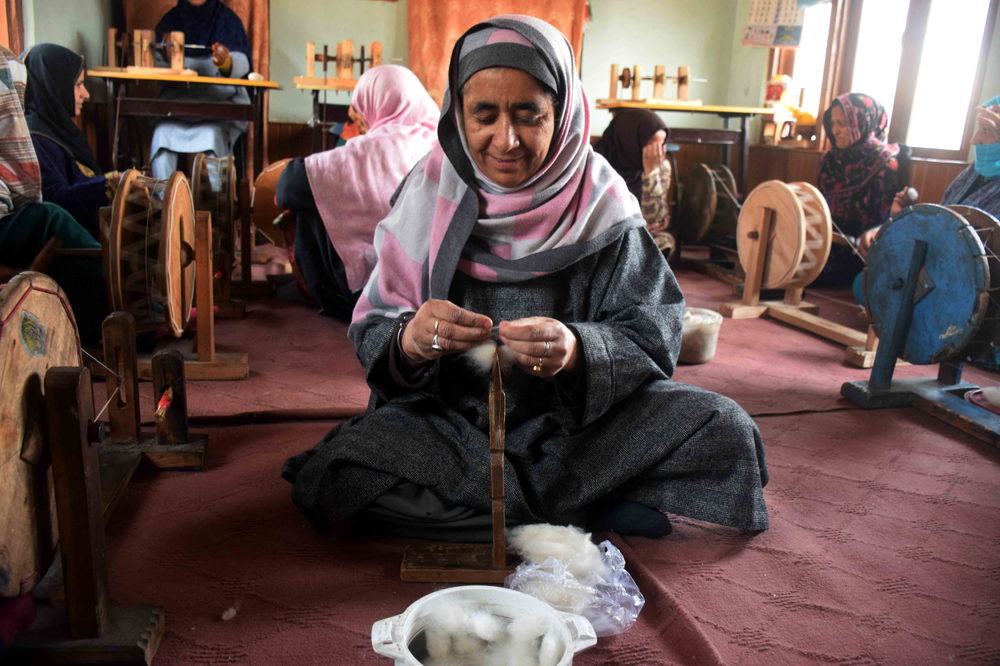
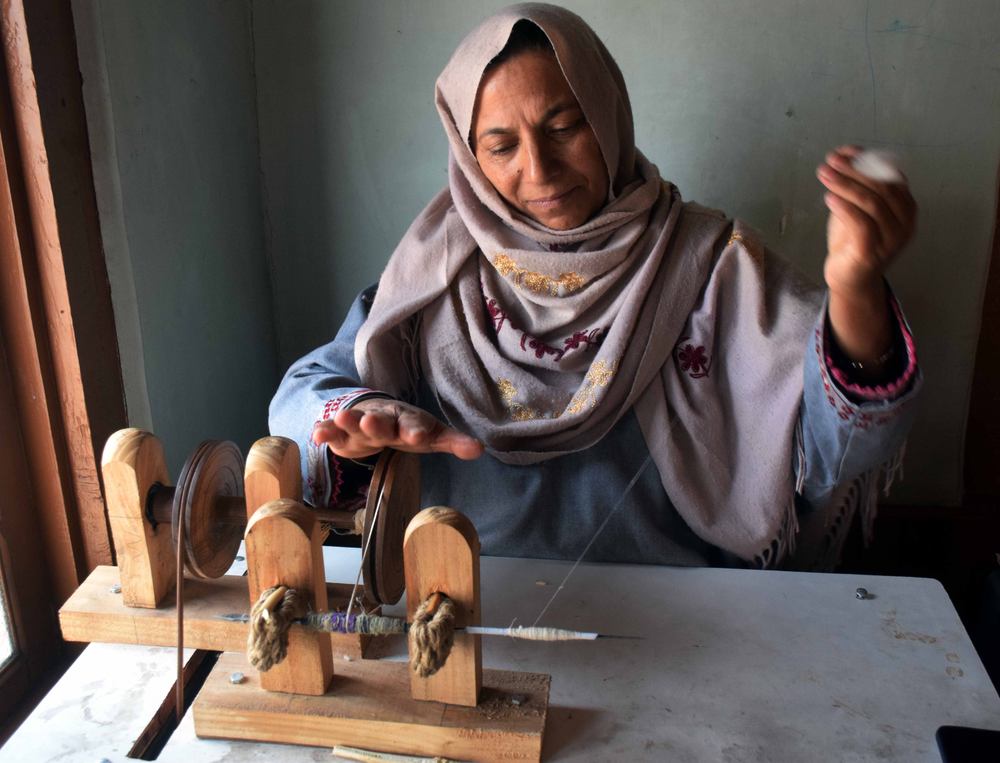
The spinning wheel used in Kashmir, called yender or charkha has been of great social and cultural value to the region.
Yender spinning was once the sole means of women’s economic empowerment in Kashmir. It is now almost extinct and has been replaced by modern machines. The boom in the textile industry and industrialisation have contributed to the decline of this craft. Most of the textiles now come from the Ludhiana garment factories.
Heavy woolen quilts, blankets, pherans, large coats, trousers and caps were previously made of wool and were used by people during winters to keep warm in winter. This has now been replaced by modern textiles and synthetic clothing. The ban on Shahtoosh also hit the trade. This craft requires patience and perseverance which is found lacking in present times. Also, the spinners are often exploited by middlemen also, resulting in meagre income and less returns for them.
Elderly women used to sing Hamad, Naa’t and munqabat and do zikr azkar while spinning. The profession was inherited by them and was, therefore, sacred. While spinning, the elderly women also told stories to younger ones in poetry and prose. The art of spinning was also adopted by renowned Kashmiri women like Habba Khatoon and Lal Ded. Habba Khatoon has mentioned Yender in one of her famous poems.
Yender had slight variations for different types of spinning, i.e., for wool, pashmina and silk. However, its basic construction was the same, for which a special kind of wood was used. The raw material for spinning was generally the local wool, which was homespun by weavers in the villages, or the pashmina brought from Ladakh by the pashmina traders. The woolen blankets used to be Ekbari, Dubari, white, black, or Khudrang and Jud Pattu.
Yender manufactured by local carpenters, consisted of an H or T-shaped base on which are mounted two drive wheels which were run by using a handle called tchaker. It consisted mainly of two parts, the front and the rear, the two parts connected by a thick string called Yuni that was rubbed with some form of oil/fat to make it extra strong. This acted like a belt and pulley mechanism. There is a spindle fitted in the front called tull or takla. The charkha has now now undergone several changes. The last two photos show use of a foot operated spinning wheel, which has been a new innovation.
Kashmir has received GI tagging for hand spun and handwoven pashmina, to guarantee authenticity. Along with this traditional practices need to be encouraged and measures should be taken to avoid middlemen making profits.