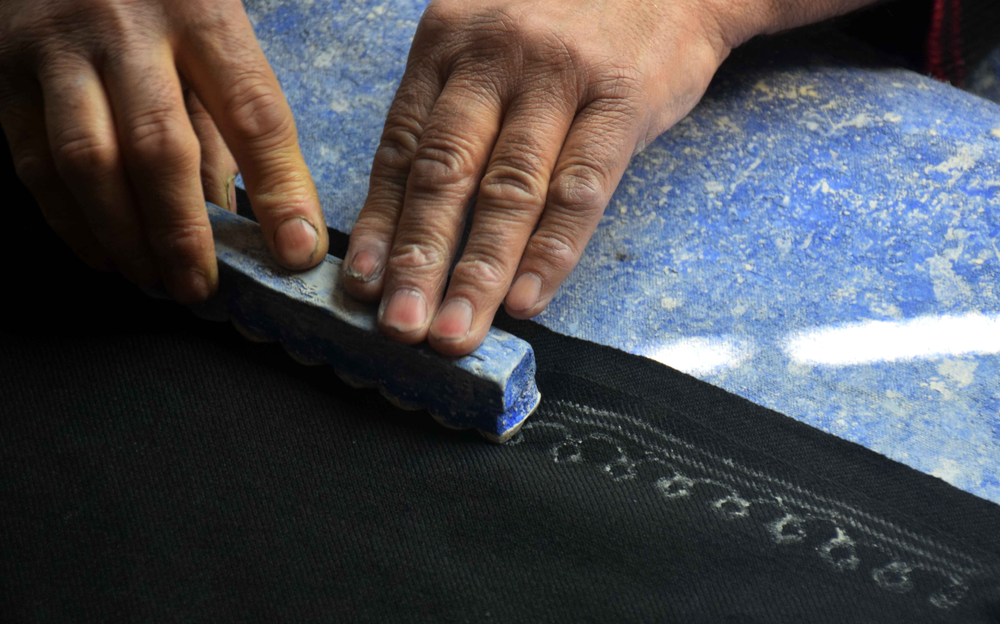
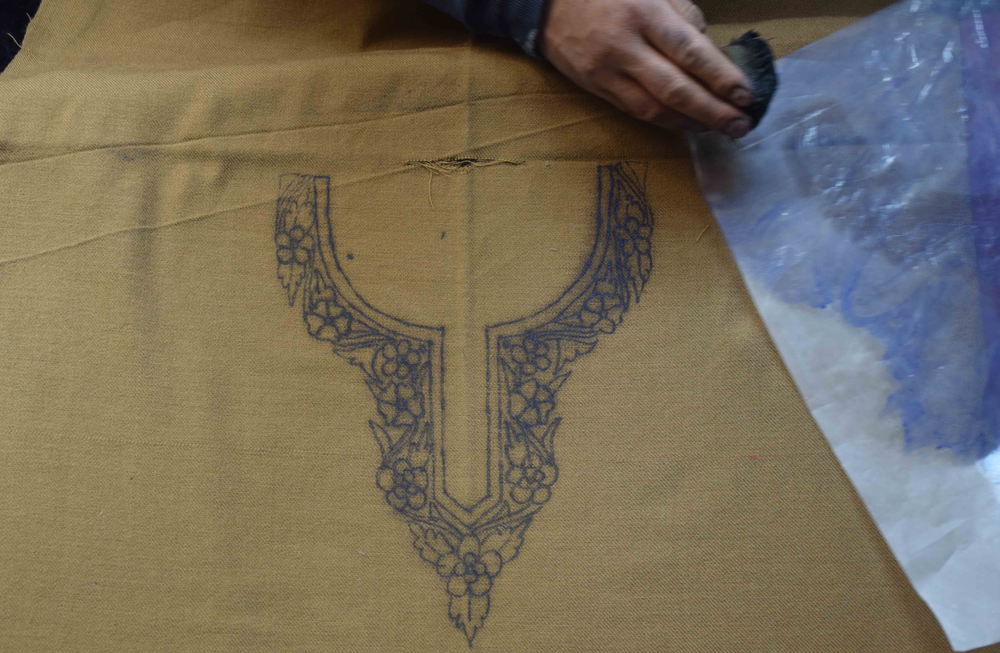
Print work of Kashmir is a unique form of traditional printing that combines wooden blocks and hand pressed paper still practiced in Kashmir. These are later used by design printers, commonly known as Naqashs for printing Shawls and other clothing items.Intricate designs are created through vibrant colours, known as naksha by naksha walas. Nakshai work in Kashmir had an intense market and formed an important part of the culture of Kashmir.
Blocks of various measurements are cut from walnut lumber and seasoned and as soon as they are dry, different designs are carved out on them according to the actual designs received on paper using various tools. Then oil is applied to let the blocks set. It is not an easy job and demands a lot of time and concentration.
A Naqash workshop is usually a big dark room with a pungent smell of dyes. The workers grubby and calloused hands are stained with ink and adhesive as they apply the ink on patterned blocks to print impressions on Shawls.
Apart from printing various designs on Pashmina, Count and other types of Shawls and stoles, some imprinters also print sarees, Suits, pherans, furnishings, etc., using various types of designs blocks meant for sozni, aari, tilla work or any other handicraft.
When the design made on a walnut wood block comes to the printer, he uses it to print all items by applying ink to it. This is no ordinary ink. It is made by the imprinter himself by adding Saresh (a kind of adhesive) to the boiling water. Then its steam is used to moisten the ink they get from the market (which is usually black or white or sometimes blue). This ink is basically carbon or zinc. Earlier, the hay that was collected around chimneys and fireplaces was used as ink. The ink is applied on hand and tapped on the block. Then its impression is pressed on a shawl or any cloth.
In some places, people use trace paper for printing but it is not preferred much as it comes with its share of disadvantages. This method is usually used in tilla work and other related works where it could be concealed with embroidery but not in the case of shawls and sozni (needle-art). Trace paper printing is cheaper and kerosene is used in the process which may lead to many issues. Also, the ink is permanent and cannot be washed away easily.Such technique is mostly used outside Srinagar in villages such as Makhama, Beerwa.
The imprinters mainly have their workshops in Kawdara, Rajouri Kadal, Naid Kadal, Bohri Kadal, Safa Kadal, Nowhatta and other places of Srinagar. There are many who belong to areas outside Srinagar.
Farooq, a resident of Eidgah, downtown Srinagar has been in this business for the last 20 years. He earned his livelihood, from this work, for well over a decade but unfortunately it is a dying form of art.
Although Farooq trains a few still interested in the art form in his workshop, computerized prints made have made it difficult for the people like him. In addition, the age-old tradition of keeping the art in the family and not giving it away, and the reluctance of new generation kids to learn or pursue this craft as it demands a lot of time and effort with minimal benefits, has fewer continuing with this art.
One of the most renowned printing place used to be in Maharaj Gunj which was turned into a Naqash workshop by Ghulam Qadir Naqash of Zoonimar who used to draw and carve designs and his brother Ghulam Nabi Naqash who used to print along with many other employees. However, several years ago with the death of one of the owners of the workshop and some other unknown reasons, it was closed and the building stays there completely abandoned.
One of the workshops Shahnawaz Naqash House was established some 40 years back by an eminent Sozni artist, Habibullah Phalguru who used to draw his own designs on butter paper and send them out for carving on walnut wood. He made the workshop along with his son Shahnawaz Phalguru near his house at Naid Kadal.